Category Archives: Food

Two Lemon Soups

Adas bil hamoud (aka sour lentil soup)

Versions of this soup, in which lemon is king, are found all over the Arab world. This is an Ottolenghi soup but changes depending on what kind of stock I have in my freezer, or herbs in my fridge, so feel free to play around with the ingredients as you see fit. I like my soup super lemony, but adjust this to your taste, too. If using vegetable stock, consider adding a couple of teaspoons of miso paste to enrich the broth. 
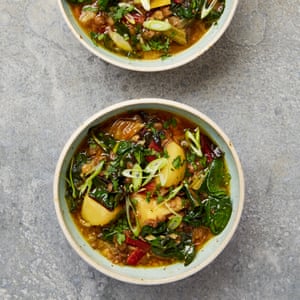
Yotam Ottolenghi’s adas bil hamoud (sour lentil soup).
 Yotam Ottolenghi’s adas bil hamoud (sour lentil soup).

Prep 25 min
Cook 1 hr
Serves 4-6

200g brown or green lentils
110ml olive oil
2 large onions, peeled and finely chopped 
5 large garlic cloves, peeled and crushed
1½ tbsp cumin seeds
3 lemons – finely shave the skin off 1 into 5 wide strips, then juice all 3 to get 75ml
Salt and black pepper
3 firm, waxy potatoes, such as desiree, peeled and cut into 4cm pieces (650g-700g net weight)
400g Swiss or rainbow chard, leaves and stalks separated, then roughly sliced
1 litre vegetable stock (or chicken or beef, if you prefer)
1½ tbsp coriander leaves, finely chopped
2 spring onions, finely sliced on an angle

Put the lentils in a medium saucepan, cover with plenty of cold, lightly salted water and bring to a boil. Turn down the heat to medium and simmer for 20-25 minutes, until the lentils are nearly cooked but still retain a bite, then drain.

While the lentils are cooking, put 80ml oil in a large, heavy-based pot for which you have a lid, and put on a medium heat. Once hot, add the onions, garlic, cumin, lemon skin, two and a quarter teaspoons of salt and plenty of pepper. Cook for about 15 minutes, stirring often, until very soft and golden. Stir in the potatoes, lentils and chard stalks, pour in the stock and 800ml water, bring to a gentle simmer, then cover and leave to cook for 20 minutes, or until the potato is soft but still holds its shape.

Turn off the heat, stir in the lemon juice and chard leaves, and leave to cook in the residual heat for two or three minutes, until wilted. Divide between four bowls, drizzle over the remaining two tablespoons of oil, garnish with the coriander and spring onion, and serve hot.

Herb, spinach and burnt aubergine soup

This soup draws on both Middle Eastern and Indian techniques, and is everything you’d want from a bowl: it is smoky from the burnt aubergine, earthy from the greens and spicy from the tempered oil. 

Yotam Ottolenghi’s herb, spinach and burnt aubergine soup.
 Yotam Ottolenghi’s herb, spinach and burnt aubergine soup.

Prep 25 min
Cook 1 hr 25 min
Serves 4 as a starter

3 aubergines
3 tbsp lemon juice
Salt and black pepper
105ml olive oil, plus extra for greasing
2 onions, peeled and finely chopped 
6 garlic cloves, peeled and crushed
60g coriander leaves, roughly chopped, plus 2 tbsp extra picked leaves
60g parsley leaves, roughly chopped, plus 2 tbsp picked leaves, to serve
40g dill leaves, roughly chopped, plus 2 tbsp picked leaves, to serve
5 spring onions, finely sliced 
2½ tsp ground cinnamon
2½ tsp ground cumin
1⅛ tsp ground turmeric
400g baby spinach, finely shredded
500ml vegetable stock
1 red chilli, cut into ¼cm-thick slices
2 tsp black mustard seeds

Put a well-greased griddle pan on a high heat. Randomly poke the aubergines all over a few times with the tip of a small, sharp knife. Once the pan is smoking hot, lay in the aubergines and cook, turning occasionally, until deeply charred on the outside and softened inside – about 50 minutes. Don’t worry about over-charring them: the longer they cook, the better. Transfer the aubergines to a colander set over a bowl and leave to drain for 30 minutes. Remove and discard the blackened skin and stems, then tear the flesh into long strips. In a medium bowl, mix the aubergine flesh with a tablespoon of lemon juice, a third of a teaspoon of salt and a good grind of pepper. Set aside until needed.

While the aubergines are grilling, start on the soup. Heat four tablespoons of oil in a large saucepan on a medium-high heat. Add the onion and cook, stirring often, until softened and deeply browned – about 12 minutes. Add the garlic, cook for 30 seconds more, until fragrant, then turn the heat to medium-low and add the chopped herbs, spring onions and three tablespoons of water. Leave to cook, stirring often so the herbs don’t catch, for about 15 minutes, until deeply green and fragrant. Turn up the heat to medium-high, add the cinnamon, cumin and a teaspoon of turmeric, cook for 30 seconds, then stir in the spinach, stock, 400ml water, a teaspoon and three-quarters of salt and a generous grind of black pepper. Bring to a boil, then lower the heat to medium and leave to simmer for about 20 minutes.

Remove from the heat, transfer 350g of the soup mix to a blender and blitz smooth. Stir the blitzed soup back into the pan, add the remaining two tablespoons of lemon juice, and keep warm.

For the tempered oil, put the chilli and remaining three tablespoons of oil in a small frying pan and turn the heat to medium. Leave to cook, stirring occasionally, until the chilli is translucent and glossy – 10-12 minutes. Add the mustard seeds, cook for a minute, stir in the final eighth of a teaspoon of turmeric, then immediately tip the mixture into a bowl to stop it cooking further. 

To serve, divide the soup between four bowls. Stir the picked herbs into the aubergines, spoon on top of the soup, and finish with a drizzle of the tempered oil and spices.

Quick Pickles

Whenever I have onions or other vegetables to use up, this is a good “waste not” recipe. It not only preserves them, but upcycles them into a garnish to use on top of stews, salads and stir-fries.

To sterilise a jar, either trust to your dishwasher or wash it in very hot water, then put on its side in a cold oven (ideally, sterilise a batch, to make the most of the oven energy). Turn the oven to 150C, then, when it reaches temperature, turn it off. Leave the jars inside until needed. To sterilise the lids, put in a saucepan of water, bring to a boil, then turn off the heat and leave in the water until needed.

Makes 1 x 500ml jar

2 large red onions or other veg (good for chillies in our house) (about 400g), peeled and thinly sliced
275ml water
100ml vinegar
10g salt
1 tsp sugar
 (optional)
¼ tsp coriander seeds (optional)
1 bay leaf (optional)
¼ tsp chilli flakes
 (optional)

Put the onions in a 500ml sterilised jar. In a saucepan, combine the water, vinegar, salt and sugar, if you like your pickles sweet and sour. Add the coriander seeds, bay leaf and chilli flakes, if using, then bring to a boil, stirring occasionally, until the salt and sugar dissolves. Carefully pour the hot pickling liquor over the onions a little at a time, so as not to crack the jar, until covered, then loosely cover with the lid. Leave to cool, then tighten the lid to seal and store in the fridge. The pickles are ready to eat immediately; once opened, they’ll keep for two or three weeks.

Corn Tortillas

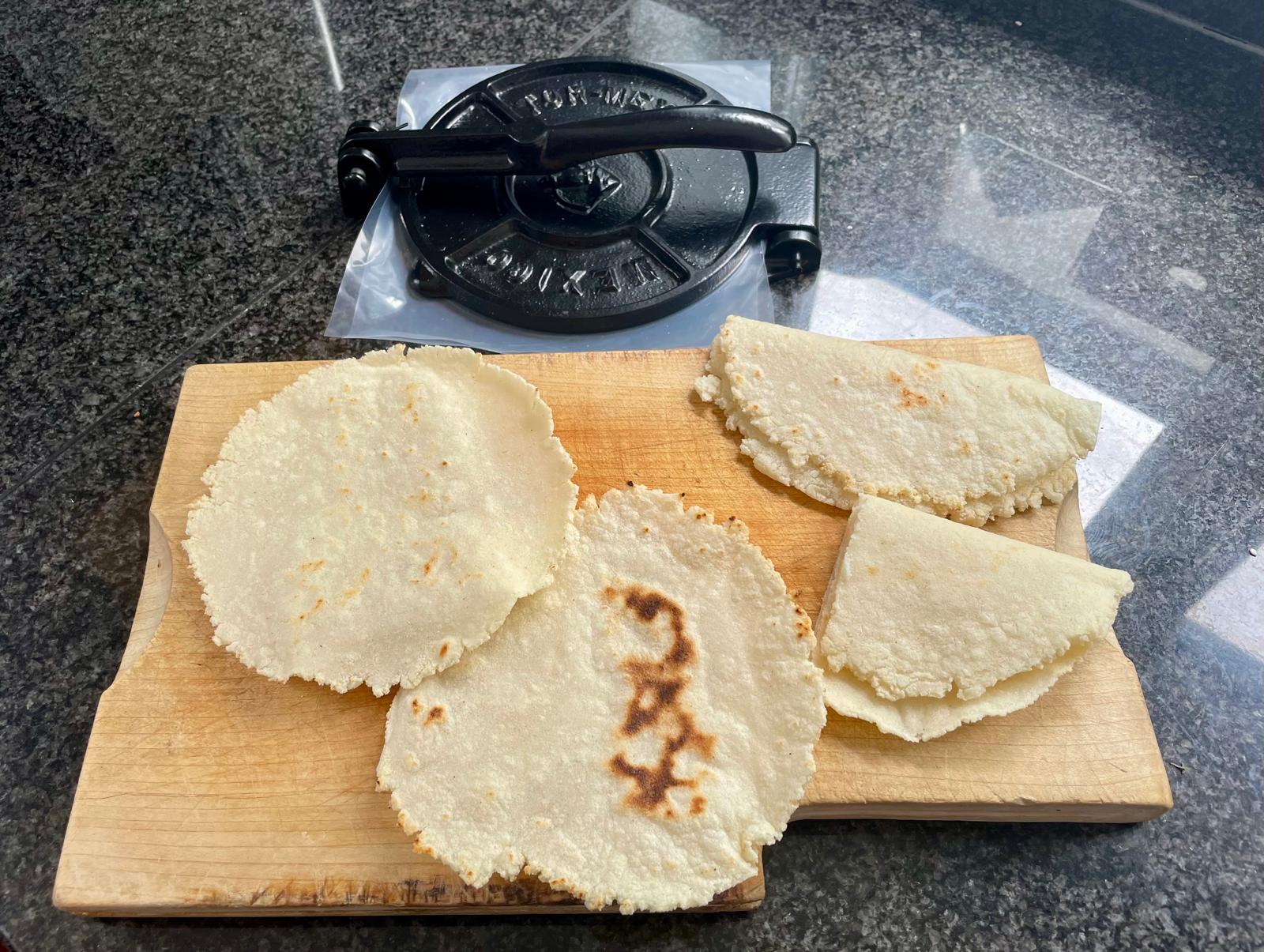
In the on-going search for pesach recipes for my daughter, South America deserves a visit. This homemade corn tortillas recipe is easy to make with 3 ingredients and yields the most delicious, soft, foldable, and gluten-free tortillas and though a tortilla press is useful (you can also roll thin) it’s a piece of kit that doesn’t cost very much.

INGREDIENTS

  • 2 cups (240 grams) masa harina
  • 1 1/2 cups hot (not boiling) water
  • 3/4 teaspoon salt

INSTRUCTIONS

  1. Mix the dough: In a large mixing bowl, briefly whisk together masa harina and salt.  Gradually add 1 1/2 cups hot water, and stir the mixture with a wooden spoon or silicone spatula until an evenly-mixed dough begins to form.  Use your hands to knead the dough for 2-3 minutes in the mixing bowl until it is smooth and forms a cohesive ball.  There is no gluten in the corn flour so no value in kneading beyond bringing it together into one cohesive mass. The dough’s texture should feel springy and firm, similar to Play-Doh.  If the dough feels too wet and is sticking to your hands, add in a few extra tablespoons of flour.  If it feels too dry and crackly, add in an extra tablespoon or two of hot water.
  2. Rest the dough. Cover the bowl with a damp kitchen towel (or paper towel) and let the dough rest for 5-10 minutes.
  3. Portion the dough. Use a spoon or a medium ice cream scoop to portion the dough into a 2-tablespoon ball (35-40 grams, or about the size of a golf ball), then use your hands to roll the ball until it is nice and round.
  4. Press the dough balls. Place the dough ball between two pieces of plastic in a tortilla press (ziplock bags work)  Then gently press the dough ball until it forms a 4- to 5-inch tortilla. If you don’t have a tortilla press, roll it out as thinly as possible.
  5. Cook the tortilla. Heat a non-stick skillet or comal over medium-high heat.  Once the pan is nice and hot, gently peel the tortilla away from the plastic wrap and lay the tortilla flat in the skillet.  Cook the tortilla for 1-2 minutes per side, flipping it once speckled brown spots begin to appear on the bottom of the tortilla.  The tortillas will likely bubble up while cooking, especially on the second side, which is a good sign!  Once it is cooked, transfer the tortilla to a tortilla warmer or a bowl wrapped in a clean kitchen towel, so that the tortillas do not dry out.
  6. Repeat with the remaining tortillas. I recommend keeping the cycle going by cooking one tortilla while pressing the next dough ball at the same time.  If you notice that the skillet begins to seem too hot, just turn down the heat a bit.
  7. Serve. The tortillas will continue to soften a bit more as they sit in a stack in your tortilla warmer (or wrapped in a towel). So I recommend using the tortillas at the bottom of the stack first — they will be the softest.  Serve however you would like and enjoy!

Mandelbrot Biscuits (Pesach)

A recipe for my daughter who is converting to Judaism. It’s suitable for Passover, an Eastern European Jewish recipe, similar to Italian biscotti. This version comes flavoured with orange zest, dark chocolate and almonds but the flavourings can be varied.

Pieces of almond, orange & ginger Pesach mandelbrot

Makes about 30 Easy Prep:  Cook:  plus cooling

Ingredients

Method

  • Heat the oven to 150C/130C fan/gas 2. Line two baking sheets with baking parchment. Mix the ground almonds, matzo meal and a large pinch of salt in a large bowl and set aside.
  • Beat the eggs, oil and sugar for 3-4 mins in a stand mixer fitted with the whisk attachment (or using an electric whisk), until pale and airy then whisk in the orange zest. Stir in the ground almond mixture, then the chocolate chunks and blanched almonds.
  • Halve the dough and, with damp hands if it’s sticky, make two oblong logs, each about 5cm wide. Put them on the baking sheets and bake for 45 mins. Cool on the baking sheets for 10 mins. Reduce the oven to 140C/120C fan/gas 1. Transfer the baked dough to a chopping board and, using a serrated knife, cut each one diagonally into slices that are 1.5-2cm wide.
  • Turn the baking parchment over, put the biscotti back on the baking sheets and bake for another 15 mins. Remove from the oven, turn them over, then bake for another 15 mins until firm to the touch on the outside but still soft on the inside. Keep an eye on them to make sure they do not get too dark. They will get more crunchy as they cool. Cool for 5 mins on the tray, then slide the parchment and cookies onto a wire rack to cool completely. Will keep in an airtight container for up to 10 days.

Arepas

With one of my daughters converting to Judaism, I’m always on the look out for recipes that might be useful for various festivals. This is not least due to the challenges of Passover or Pesach, where no rising agents are allowed, basically no wheat or wheat products, much rules out most ready made or processed foodstuffs. Potatoes and yet more potatoes seem to be the obvious Northern European answer, a challenge for breakfast.

Yet over in South America, corn reigns supreme and it seems worthwhile taking a look at this recipe for cheese filled arepas …

Prep 10 min
Cook 10 min
Makes 6

100ml milk, whole milk, ideally
½ tsp fine salt
200g masarepa
, or white pre-cooked cornmeal
100g salty white cheese (eg, queso fresco, feta or similar), crumbled
60g firm mozzarella
Oil

Butter
, to finish

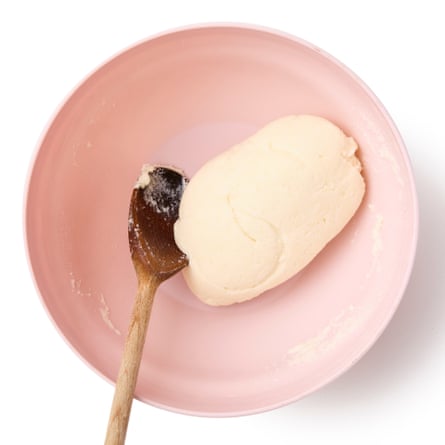
Put the milk and salt in a arge bowl with 220ml hot water. Sprinkle over the cornmeal and stir in until the mix comes together into a soft dough (add more liquid if necessary).

Put the milk and salt in a large bowl with 220ml hot water. Sprinkle over the cornmeal and stir in until the mix comes together into a soft dough (add more liquid if necessary).

01c Felicity Cloake’s arepas . stir in until the mix comes together into a soft dough (add more liquid if necessary).

Stir in the crumbled white cheese, cover and leave to sit for 15 minutes. Meanwhile, grate the mozzarella.

some cheeses. In a bowl. Stir in the crumbled white cheese, cover and leave to sit for 15 minutes. Meanwhile, grate the mozzarella.

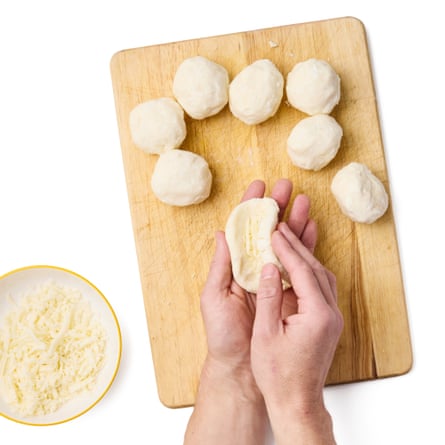
Using damp hands, divide the dough into six even pieces, roll into balls, then, working one ball at a time and on a wooden surface for ease, flatten one to about 8cm wide and a little shy of 1cm thick.

02b Felicity Cloake’s arepas ... Using damp hands, divide the dough into six even pieces, roll into balls, then, working one ball at a time and on a wooden surface for ease, flatten one to about 8cm wide and a little shy of 1cm thick.

Add a generous helping of grated mozzarella, then bring up the sides to enclose the cheese.

02c Felicity Cloake’s arepas. Discs of uncooked cheesy dough. Add to the dough a generous helping of grated mozzarella, then bring up the sides to enclose the cheese. Roll again into a ball, then flatten again to 8cm wide and 1cm thick, turning it around inside your damp cupped hands to smooth out the edges.

Roll again into a ball, then flatten again to 8cm wide and 1cm thick, turning it around inside your damp cupped hands to smooth out the edges.

Put a lightly greased, heavy frying pan on a medium heat and, once it’s hot, add as many arepas as will fit comfortably without them touching.

03a Felicity Cloake’s arepas cooking in a pan. Put a lightly greased, heavy frying pan on a medium heat and, once it’s hot, add as many arepas as will fit comfortably without them touching. Immediately turn down the heat to medium-low, cover (use a baking tray, board or foil if you don’t have a pan lid) and cook, shaking the pan occasionally to stop the arepas sticking, for about five or six minutes, until the base is golden brown. Turn over, repeat on the other side and serve spread with butter to serve.

Immediately turn down the heat to medium-low, cover (use a baking tray, board or foil if you don’t have a pan lid) and cook, shaking the pan occasionally to stop the arepas sticking, for about five or six minutes, until the base is golden brown. Turn over, repeat on the other side and serve spread with butter to serve.

Sweet Chile Grain Tofu Bowl With Tofu

I’m trying a new recipe each week, some with more success than others…

Sweet Chile Grain Bowl With Tofu

Total Time 50 minutes Prep Time20 minutesCook Time30

You can use any kind of cooked grain as the base of this colorful, deeply flavored tofu and cabbage bowl. The grains, vegetables and tofu add texture, heft and protein, but the real star is the sauce, a mix of chile crisp, garlic and soy sauce sweetened with ketchup. Brushed onto the tofu and cabbage before roasting, the sauce caramelizes and mellows. Drizzled on top of the bowl right at the end, it stays bright and snappy. Fresh cherry tomatoes tossed with more chile crisp make a juicy, spicy garnish, but you can leave them out if you don’t have any on hand.

Ingredients

Makes: 4 servings

  • 1 package firm or extra-firm tofu
  • ¼cup neutral oil, such as rapeseed
  • 2garlic cloves, grated or minced
  • ¼cup ketchup
  • 1½tablespoons soy sauce
  • 1½tablespoons miso
  • 1tablespoon chile crisp, more to taste
  • 1teaspoon rice vinegar
  • 1½cups cherry tomatoes, halved
  • ½teaspoon fine sea or table salt, more to taste
  • 1½pounds napa cabbage, halved lengthwise, cored and sliced crosswise ½ inch thick
  • 1bunch spring onions, thinly sliced
  • 1lime, cut into wedges (or use more rice wine vinegar)
  • 4cups cooked grains (rice, couscous, bulgur wheat or whatever else you have on hand) or salad greens
  • Chopped cilantro, for serving

Preparation

  1. Heat oven to 200C degrees. Line a baking sheet with parchment paper.
  2. Cut the tofu into 1-inch-thick slabs. Cut each slab in half to make squares. Line a plate or baking sheet with paper towels and place tofu on top. Place another layer of paper towels on the tofu and weigh down with a skillet or cans. Let sit for at least 15 minutes.
  3. While the tofu is draining, make the sauce: Heat the oil in a small pot or skillet over medium-high. Stir in the garlic and let cook until fragrant, about 1 minute. Whisk in ketchup, soy sauce, miso, ½ tablespoon of the chile crisp and the rice vinegar. Set aside to cool for a few minutes.
  4. In a small bowl, mix together the tomatoes, the remaining ½ tablespoon chile crisp and a pinch of salt. Set aside.
  5. Place tofu on one side of the prepared baking sheet and generously brush both sides of the pieces with the sauce.
  6. Add the cabbage to a bowl, sprinkle lightly with salt and toss with ¼ cup sauce. (Reserve remaining sauce for serving.) Spread cabbage on the other side of the baking sheet in an even layer.
  7. Roast tofu and cabbage for about 30 minutes, tossing the cabbage after 15 minutes. The tofu should be lightly golden at the edges and the cabbage tender and bronzed. Toss about half of the scallions into the cabbage and squeeze lime wedges over everything (or drizzle with a little rice vinegar). Taste cabbage and add more salt or sauce, if needed.
  8. To serve, put 1 cup grains in each of 4 bowls. Drizzle the grains with a little of the sauce. Top with tofu, cabbage and spicy tomatoes. Garnish with cilantro and remaining scallions, and drizzle with remaining sauce. Serve warm or at room temperature.

Butter Paneer

The future SiL who loves all things cheese, adores this recipe but since it’s quite rich, a fresh green side dish is probably advisable.

Ingredients

Yield:4 servings

  • 1½pounds paneer, cut into ½-inch cubes
  • 2tablespoons ghee or neutral oil
  • 1teaspoon freshly grated ginger or ginger paste
  • 1teaspoon freshly grated garlic or garlic paste
  • 1small white onion, finely chopped
  • 1teaspoon Kashmiri red chile powder
  • 1teaspoon garam masala
  • 1(14-ounce) can of crushed tomatoes, or 6 plum tomatoes, chopped
  • 2tablespoons cashew butter
  • 2tablespoons unsalted butter
  • Salt and freshly ground black pepper
  • 3 green chiles, chopped (optional)
  • 1tablespoon chopped cilantro (optional)
  • Rice or roti, for serving

Preparation

  1. 1If using store-bought paneer, soak the cheese in hot tap water for 10 minutes; drain.
  2. In a medium pot, heat ghee on high until it melts, 30 to 90 seconds. Stir in ginger and garlic and cook until the smell of raw garlic dissipates, about 30 seconds. Add onion and continue cooking, stirring occasionally, until onion is translucent, 5 to 7 minutes.
  3. Add chile powder and half of the garam masala and cook until deliciously fragrant, about 30 seconds. Stir in the tomatoes and cashew butter. Cook, stirring occasionally, until the tomatoes start to break down, 5 to 7 minutes.
  4. Adjust heat to medium and add the butter. Cook until butter has melted into the mixture, about 30 seconds. Stir in 1 teaspoon salt and add water if a thinner sauce is desired. Taste and add more salt if necessary. Stir in the paneer cubes. Simmer for 5 minutes on low, until the flavors have melded. Top with the rest of the garam masala and the green chiles and cilantro, if using. Serve with rice or roti.

Green salsa

2 cups fresh mint leaves, chopped

1cup coriander leaves, chopped

2 green chillies

2tbsp fresh squeezed lemon (1 large lemon)

2tbsp greek yoghurt

2tsp cumin seeds, crushed

2 garlic cloves

1 tsp sugar

Add all of the above to a food processor and combine.

Above is a recipe from the NYT which it uses to dress cooked chicken before serving in lettuce ‘cups. Having tried it with vegetarian chicken, I actually think it’s better either as a stand alone salsa or with a more crunchy kind of vegetable base, maybe finely sliced and cut kohlrabi?

It’s useful because having moved into her new house last year, my daughter has made a raised bed for herbs and is now over-run with coriander, parsley and mint. The latter is at least planted outside of the bed but I am reminded that every gardener, no matter how skilled, spends the first year planting and the next ten years weeding out what they’ve planted.

Challah

I make this bread over two days, letting it rise overnight in the fridge before knocking the dough back, shaping and baking. Rather than raisins, I tend to flavour it with rosemary or (family favourite) cheese and crispy onion, most often in a spiral rather than the beautiful but complicated braid this recipe describes.

As someone who prior to this recipe had every attempted loaf of bread turn out positively brick like, I won’t say that it’s foolproof but aside from the braiding (which you can skip) it’s the best and easiest loaf recipe that I’ve come across.

Ingredients

Yield:1 large loaf or 2 small

  • 1teaspoon active dry yeast
  • 1¼cups/169 grams bread flour
  • ½cup/72 grams golden raisins (optional)
  • ⅓cup/113 grams honey
  • ⅓cup/75 grams extra-virgin olive oil
  • 1large egg yolk, at room temperature
  • 2large eggs, at room temperature, plus 1 beaten egg, for egg wash
  • 3cups/405 grams bread flour, plus more for kneading the dough
  • 11grams or 1½ teaspoons coarse salt)
  • Poppy or sesame seeds, for sprinkling (optional)

Preparation

  1. Make the preferment: In a medium bowl, combine the yeast and ¼ cup/57 grams warm tap water (100 to 110 degrees), and whisk until the yeast is dissolved. Add another ½ cup/113 grams room temperature water and the bread flour, and stir with a flexible spatula or bowl scraper until you have a smooth, pasty mixture with no dry spots. It should look like a thick batter.
  2. Scrape the mixture into the center of the bowl and cover tightly. Let the preferment sit at room temperature until it’s nearly tripled in size, extremely bubbly across the surface, and jiggles on the verge of collapsing when the bowl is shaken, 1 to 2 hours (depending on the ambient temperature).
  3. If making a raisin-studded challah, while the preferment is getting bubbly, place the raisins in a medium bowl and cover with boiling water. Cover the bowl and let the raisins soak until they’re plumped and softened, 15 to 20 minutes. Drain the raisins, pat them dry, and set aside.
  4. Mix the dough: In a medium bowl, whisk together the honey, olive oil, the yolk and 2 of the eggs until smooth, then add to the bowl with the preferment. Add the bread flour and salt. Use a flexible spatula or bowl scraper to stir the mixture, making sure to scrape the sides and bottom of the bowl to incorporate the preferment, until a shaggy dough comes together.
  5. Knead the dough: Generously flour the work surface, then scrape the dough and any floury bits out of the bowl and onto the surface (reserve the bowl). Generously flour the dough. Use the heel of your hands to knead the dough, adding flour as needed if the dough is sticking to your hands or the surface, until the dough is very smooth, elastic and slightly tacky, 10 to 15 minutes. (You can also combine everything in a stand mixer and mix on low speed with the dough hook for 8 to 10 minutes, adding more flour as needed until the dough pulls away from the sides of the bowl.)
  6. Test the dough: Pinch off a golf ball-size piece and flatten it with your fingertips. Stretch the dough outward in all directions gently and slowly: You should be able to form a sheet of dough that’s thin enough to allow light to pass through without tearing. If the dough tears, continue kneading. For a raisin-studded challah, use your hands to flatten the dough into a 1-inch-thick slab (the shape doesn’t matter) and scatter the drained raisins over the dough. Roll up the dough and gather it back into a ball, then knead until the raisins are distributed throughout.
  7. Let the dough rise: Gather the dough into a smooth ball, dust lightly with flour and place back in the reserved bowl. Cover and let the dough sit in a warm spot until it’s doubled in size, 1 to 2 hours (depending on the ambient temperature). Alternatively oil a bowl and leave the dough in the fridge, covered, to rise overnight.
  8. Divide the dough. I usually make two smaller loaves but for a single loaf: Punch down the dough inside the bowl to expel the gasses that built up during the first rise, then scrape the dough out onto a clean work surface. For a braided loaf, use a bench scraper or knife to divide the dough into 6 equal pieces. (You can eyeball it, or weigh the pieces for accuracy — each piece should weigh 180 to 190 grams.) For a round loaf, divide the dough in half.
  9. Braid or twist the dough, twists are easier. For a braid, roll each of the 6 pieces into snakes measuring about 18 inches long and slightly tapered at the ends. Dust the strands in flour to coat them lightly, then line them up so they’re side by side. Pinch together the ends of the strands to connect them at the top.
  10. Take the strand on the far right and cross it over the other strands, so it’s all the way on the far left side, placing it perpendicular to the other strands. Then, take the strand that was originally on the far left, and is now second from the left, and bring it all the way to the far right, also placing it perpendicularly.
  11. Fan out the remaining strands so there’s a generous space in the center. Take the strand on the far left and bring it to the center, but group it with the strands on the right. Next, bring the strand that’s second from the right and cross it over to the far left, also placing it perpendicular. Then, fan out the strands again, leaving a space in the center, and bring the strand on the far right to the center, grouping it with the strands on the left. Bring the strand second from the left to the far right and cross it over to the far left. Then, repeat this process until you’ve braided the entire length of the strands, tugging gently on the strands as you work to create tension in the braid. Pinch the ends of the braids and tuck them underneath the loaf, then transfer to a parchment-lined sheet pan. Make sure you have a couple of inches of clearance on either side of the braid so it can expand.
  12. Alternatively, for a round, roll the two pieces of dough into long snakes measuring about 28 inches long, making sure to taper the snakes at one end. Dust the strands in flour to coat them lightly, then line them up so they’re side by side with the tapered ends aligned. Twist the two strands together, then start at the tapered end and roll up the twist into a tight coil, wrapping the fatter end around and tucking the end underneath the coil. Transfer the coil to a parchment-lined sheet pan.
  13. Egg wash and proof the dough: Beat the remaining egg in a small bowl until it’s streak-free. Brush the loaf with the egg, then loosely cover the dough with some lightly oiled plastic wrap on a sheet pan, and let it rise at room temperature until it’s doubled in size, extremely puffy, and springs back but holds a slight indentation when poked gently with a wet finger, another 1½ to 2 hours (but possibly longer, depending on ambient temperature). The dough is easy to underproof, so, if you’re unsure, err on the side of overproofing. (The round loaf will also take longer to proof.) Alternatively, before proofing, you can refrigerate the dough overnight, but omit the egg wash and make sure it’s covered (plastic should cover it loosely but be sealed around the pan so the dough doesn’t dry out).
  14. Heat the oven: Arrange a rack in the centre of the oven and heat it to 200C degrees.
  15. Bake: Uncover the challah and brush with another layer of egg wash. Sprinkle the loaf with poppy or sesame seeds (if using) and bake until the loaf is shiny and burnished, an instant-read thermometer registers 190 degrees when inserted into the center, and it sounds hollow when tapped on the bottom, 35 to 40 minutes. Let the challah cool completely on the baking sheet.

Tofu Chilli Crisp

Yield:4 servings

  • 3tablespoons chile-crisp condiment, plus more for serving
  • 3tablespoons soy sauce
  • 1½tablespoons Chinese black vinegar
  • 1½teaspoons sesame oil
  • 1teaspoon honey
  • 2garlic cloves, peeled and minced
  • 2tablespoons chopped scallions
  • 2tablespoons chopped coriander
  • 1(14-ounce) package extra-firm tofu, drained and sliced crosswise into 8 (½-inch-thick) slabs
  • ¾pound green beans
  • 1tablespoon neutral oil, like rapeseed
  • White rice, for serving
  • 1tablespoon minced fresh ginger

After all of these years, I still come across ingredients and condiments like chilli-crisp that I’m left wondering how I’ve missed.

Preparation

  1. Heat oven to 200C. In a baking dish or casserole, whisk together the chile crisp, soy sauce, vinegar, sesame oil, honey, garlic, ginger, scallions and coriander leaf.
  2. Add the tofu slices to the dish, and coat them with the sauce, then allow to marinate for as long as it takes to heat the oven and trim the green beans.
  3. Add the green beans to a large sheet pan, then drizzle the neutral oil on top and toss to coat. Slide the green beans to the sides of the pan, and arrange the slices of tofu in an even layer in the center of the pan. Pour remaining marinade over the tofu, and place in oven.
  4. Roast until the green beans start to blister, 20 to 25 minutes. Serve immediately with rice and extra chile crisp on the side.