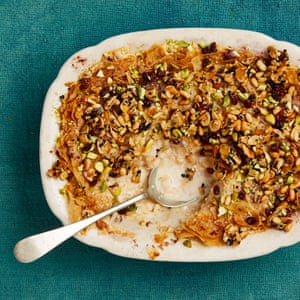

An Egyptian pudding popular across the Arab world, a bit like a bread-and-butter pudding. Instead of flatbread, pieces of baked pastry can also be used, as I do here.
Prep 10 min Infuse 1 hr+ Cook 1 hr 25 min Serves 4-6
700ml whole milk 300ml double cream 15 cardamom pods, roughly bashed open in a mortar 2 cinnamon sticks 125g caster sugar 6 feuilles de filo pastry (120g) 60g unsalted butter, melted 2 tsp runny honey 40g pine nuts 30g flaked almonds 1½ tsp white sesame seeds 1½ tsp black sesame seeds 1 tsp olive oil 1 tsp rose water 1 pinch flaked sea salt 30g desiccated coconut, lightly toasted ½ tsp ground cinnamon 20g pistachio kernels, finely chopped 1½ tbsp barberries, soaked in hot water for 20 minutes, then drained
Heat the oven to 170C (160C fan)/350F/gas 4. Put the milk, cream, cardamom and cinnamon in a medium saucepan, turn on the heat to medium-low, cover and cook for 20 minutes, or until steaming and just beginning to bubble. Turn off the heat and leave to infuse for at least an hour (or refrigerate overnight). Strain through a sieve set over a bowl (discard the solids), then pour back into the pan and add 70g sugar. Bring to a simmer on a medium heat, stirring from time to time, then set aside and keep warm.
Lay out one filo sheet on a clean work surface and brush liberally with melted butter and a teaspoon and a half of caster sugar. Top with another sheet of filo and repeat until you’ve used up all the filo and melted butter and 45g of the sugar. Transfer to a large oven tray lined with greaseproof paper and bake for 20 minutes, until golden. Remove from the oven, set aside to cool, then break into jagged, roughly 10cm pieces; it’s fine if they flake apart a little.
Put the honey, pine nuts, almonds, sesame seeds, oil, rose water and a pinch of flaked sea salt in a small bowl and mix well. Transfer to a small oven tray lined with greaseproof paper, bake for eight minutes, then stir and bake for four minutes more, or until golden. Remove from the oven, leave to cool for 10 minutes, then break into small clusters.
Turn up the oven to 190C (180C fan)/390F/gas 6. To assemble the dish, arrange half the baked filo pieces in a 24cm-long x 14cm-wide x 7cm-deep baking dish, and sprinkle over half the coconut and a quarter-teaspoon of cinnamon. Top with the remaining filo, then pour over the warm milk. Sprinkle with the remaining quarter-teaspoon of cinnamon, the remaining coconut and the last 10g of sugar. Bake for 25 minutes, or until golden and bubbling, then remove from the oven and leave to cool for about 15 minutes. Top with the pistachios, barberries and pine nut clusters, and serve warm.
Rolling over in bed before going to sleep should not result in stabbing pain in your heel, yet apparently it’s a thing, plantar fasciitis, for a moderately active woman of a certain age.
Just to re-state the obvious: menopause is crap. Growing old is not for wimps.
A few different factors can lead to heel pain, including sciatica and the heel version of carpel tunnel syndrome but one of the most common causes is plantar fasciitis.
Luckily self-care treatments can help reduce the pain and inflammation linked to plantar fasciitis so I’m going to try the obvious before panic sets in.
The following treatments are available to self-administer at home:
Ice: Advice is to apply ice three or four times a day for about 15 minutes at a time. It’s advisable to wrap an ice pack in a damp towel and place it on the heel. Since ice seems to be making things feel worse (though it is the best advice) I’m going to try relaxing with heat packs as well. My coach recommends an alternating sequence of heat and ice.
Non-steroidal anti-inflammatory drugs (NSAIDs): NSAISs may also help reduce discomfort and inflammation. Ibuprofen and paracetamol combined are my go-to pain relief so they’re definitely on the menu for the next few days
Orthotics: Foot orthotics are custom foot supports to places them in the shoes. Orthotics can support the arch, which helps evenly distribute the weight placed on the heel when a person walks. But since I spend my life in flats, and definitely use decent sports shoes, I’m going to passion these for now
Splint: Wearing a splint at night might also help. The splint stretches the arch and calf, and may decrease discomfort. At the moment this sounds like more trouble than it’s worth.
Switching activities: It might also be helpful for people to switch from high-impact activities, such as running, to exercise that is easier on the heel. Low-impact options include swimming and walking. Since I hate these and love tennis, this just isn’t going to happen
Exercises
Certain stretches can help heel pain.
Plantar fasciitis can disrupt workout routines.
Continuing to partake in certain activities can make heel pain worse, but remaining idle and avoiding exercise is not beneficial.
Exercise is still possible when dealing with plantar fasciitis. The key is to avoid activities that place a lot of force on the heel.
Stretches for plantar fasciitis
According to the American Academy of Orthopaedic Surgeons, certain stretches can help reduce heel pain and prevent plantar fasciitis from reoccurring.
People who have plantar fasciitis pain in the morning might want to carry out the following stretches as soon as they wake up.
Seated Fascia Stretch (this worked like a miracle of pain relief for as long as I held the stretch)
Sit in a cross-legged position at the end of the bed or a chair.
Place the affected foot over the knee of the other leg.
Grab the heel of the painful foot with one hand and the toes with the other hand.
Gently pull up on the toes, while at the same time pulling up on the heel. Bending the toes up stretches the fascia.
Bending the ankle up stretches the Achilles tendon, which may help decrease pain.
Hold the stretch for about 10 seconds.
Relax the foot and repeat 10 to 20 times. If both feet are experiencing pain, repeat the exercise on the other foot.
Seated Ankle Pumps (this hurt like hell a few times into the repetition)
Sitting in a chair, hold the leg out straight and flex and extend at the ankle joint.
This exercise stretches both the fascia and the calf muscle.
Hold the stretch for 5 seconds and repeat 10 times on each foot.
Standing Calf Stretch (felt it in my calf but not the heel)
Place both hands on a wall, keep the back leg straight, and place the heel down.
Pull the hips forward towards the wall until the stretch is felt in the back of the lower leg.
Hold for 10 seconds and repeat several times.
If the heel on the opposite leg hurts, repeat the stretch on that leg too.
Medical treatment options
Although home treatments can be enough to decrease heel pain from plantar fasciitis, they might not always have the desired effect.
If home treatment is not successful, a doctor might recommend additional medical treatments, such as:
Steroid injections: When heel pain persists, steroid injections are an option. The doctor injects an anti-inflammatory steroid medication into the heel. Frequent steroid injections can weaken the fascia, so injections cannot be given too frequently.
Surgery: This can be a possible last resort. There are several different surgical procedures for reducing heel pain. For example, a procedure called a plantar fascia release involves partially cutting the fascia to reduce the tension of the tissue.
Visiting a physiotherapist worked with tennis elbow (from housework rather than tennis) so I may make some appointments with my local recommended physiotherapist to see if she can work on my heel. I’ll certainly try this long before I visit the doctor for injections or the hospital for surgery.
Causes
The plantar fascia is a ligament that runs underneath the soles of the feet. It connects the heel bones to the front of the feet and also supports the arch.
The fascia normally serves as a shock absorber, but repeated stress to the heel can lead to small tears in the tissue. This tissue damage causes inflammation in the fascia known as plantar fasciitis.
There are a few different causes of plantar fasciitis. The ligament can become inflamed due to repeated force from high-impact activities and sports that involve a lot of jumping. Wearing high heels may also place stress on the fascia.
Having a job that requires a lot of standing or walking increases the chances of developing the condition. People with flat feet may also be more likely to develop plantar fasciitis. Flat feet can cause an uneven distribution of weight when someone walks, which puts added stress and pressure on the fascia.
Prevention
Choosing comfortable shoes can help reduce symptoms of heel pain.
Stretching can be helpful in decreasing the symptoms of plantar fasciitis and also preventing the condition from developing. In addition to stretching, a few steps might help prevent plantar fasciitis.
People can start by wearing the right shoes. Avoid high heels as they can place stress on the heel. Shoes with a moderate heel and sturdy arch support can help.
Be sure to always wear footwear and avoid being barefoot for long stretches of time. The lack of support could lead to heel pain.
Athletic shoes provide good support and cushion the feet. A 2011 study suggests that running or athletic shoes should be replaced every 500 miles. Start exercise slowly and gradually increase intensity to prevent plantar fasciitis.
Symptoms
The most common symptom of plantar fasciitis is pain in the heel and sometimes the arch of the foot.
The pain usually starts mild, and people often feel it when stepping out of bed in the morning, as well as after sitting for a long period. Although pain levels can vary, discomfort often decreases after walking around for a while.
The pain from plantar fasciitis can last a long time, and complications can develop. Continued inflammation of the fascia can lead to the development of scar tissue. This can make the condition harder to treat.
Plantar fasciitis can also cause pain elsewhere in the body. For example, when someone has heel pain, they might adjust the way they walk without realizing it.
Knee, hip, and back problems can develop due to changing body movements.
Playing with a website is a fun but frustrating experience.
I cannot stress how grateful I am to the guys at WordPress for making the whole process around building a website so very very straightforward and for introducing me to an entirely new world of themes and widgets.
But as the themes change, widgets stop working so there comes a point where even change averse people like myself are forced to go looking for a new piece of code or widget to replace an existing a now no longer functioning widget.
Looking for feeds from the usual social networking sites, to sit neatly in my left column to the front page of this site was both surprisingly easy and confusing. My attempts to set up a tumblr link resulted in endless posts not only to my website but also through to twitter. Weird.
Pinterest and twitter feeds to the lead page took next to no effort to set up at all. Weirder. & to be honest, I don’t want to link through to Facebook so that’s probably as far as I’ll go.
Now I’ve been reduced to looking online for reviews or articles of the best widgets.
There are few things less useful or more commonplace than myths about menstruation, starting with the basic building block idea that women experience a 28 day menstrual cycle.
Seriously? What women, living on what planet? Because I know absolutely no women with a 28 day cycle and I know lots of women.
Saying “women” have a 28 day cycle is a bit like saying “men” have 5 inch dicks and expecting that to mean something.
At best it’s talking about averages, not reality. It doesn’t give any idea of how variable either menstrual cycles or dicks actually are in practice and says nothing at all about how the real life people with said menstrual cycle or dicks actually experience them.
I have never had a 28 day menstrual cycle but for most of my 20s and 30s could be reasonably described as having a 35 day cycle i.e. 4 weeks plus one week of menstruation. As a result each of my pregnancies was automatically calculated by midwives as a couple of weeks overdue, or would have been if we hadn’t adjusted the second time around.
My midwives who could hardly be regarded as ignorant about the whole reproductive system didn’t ask when I missed my period but rather asked for the date of my last period and added 28 days to estimate the missed date to come up with an estimated due date. Since an overdue pregnancy inevitably leads to pressure for inductions or forced labour, it can be an assumption with traumatic consequences.
Unlike many of my friends and one of my daughters, my periods were at least regular as clockwork. For most people the idea of a calendar schedule for periods is more an ambition than a reality. Mostly women have a vague idea of when they’ll start to bleed rather than a firm calendar commitment.
So you may expect a period to start sometime this week, but it could be any day Monday though Wednesday, and each day will require you to be prepared.
For most of my life my periods also followed a fairly straightforward pattern, starting light and never really progressing much beyond. Mostly I had some basic cramps to start with and then nothing. I was lucky. After childbirth my periods became heavier but still relatively easy to manage.
My personal luck meant that I was entirely unprepared for the physical pain my daughters experience with intense cramps, migraines and debilitating blood loss, each and every month. For tiny women, they’re bodies seem pretty extreme. We rapidly acquired paracetamol, ibuprofen, endless hot water bottles and lots of pairs of black pants.
Of course my honeymoon period eventually ended and my physical life fell off the menopausal cliff not that long ago. Whilst I remain relatively regular and true to the 35 day cycle, there is no saying from month to month what that cycle will entail, whether a barely noticeable breakthrough bleeding or full out flooding with enough force to send a tampon shooting out of my vagina with a sudden flush of blood.
Other symptoms come and go, from hot feet at night through to a burning sensation on my skin at the beginning of my period and an almost permanent deadening sensation of the nerves on one side of my hips. My belly now becomes tender and distended with water retention just before a period such that I sometimes feel as if I’m about to burst.
More generally, I’m physically also less coordinated, my timing just slightly off when it comes to playing tennis if I don’t focus very deliberately and intellectually I can be a bit distracted when playing a game such as bridge.
And obviously there will be plenty of people who regard all of this as an entirely personal issue to deal with but….
This stuff happens to 52% of the population. It isn’t an individual issue but one that impacts that majority of people in society directly and everyone indirectly, so it seems a bit silly to suggest that it isn’t everyone’s issue or that we shouldn’t talk about these things.
At the very minimum we should be clear when we’re talking about averages and expectations when applying to them to more than half of the population and at least acknowledge the variation that can render such assumptions as useful as any other myth or fairy tale.
½cup/120 milliliters tamarind paste, extract or concentrate (see tip below)
1 to 2tablespoons lemon or lime juice, to taste (from 1 lemon or lime)
Pinch of fine sea salt
FOR THE TOPPING:
1cup/240 milliliters heavy cream
1tablespoon icing/confectioners’ sugar
PREPARATION
Prepare the crust: Heat oven to 350 degrees, and place a rack in the center of the oven. In a large bowl, stir together crumbs and butter. Transfer mixture to a 9-inch pie plate, and press it into an even layer on the bottom and up the sides.
Place pie plate on a rimmed baking sheet, and transfer to oven. Bake until golden brown, about 10 to 12 minutes. Transfer to a wire rack to cool.
Meanwhile, prepare the filling: Halve the orange and squeeze the juice from one half. You should have 1/4 cup. If not, squeeze some juice from the other half. Reserve squeezed halves for zesting for garnish.
In the bowl of an electric mixer, using the whisk attachment, beat egg yolks until pale and fluffy, about 5 minutes. Turn the mixer to low and slowly add condensed milk, scraping sides if needed. Whisk in tamarind and orange juice until just combined, then whisk in the lemon or lime juice and salt.
Scrape mixture into cooled pie shell, then return to oven and bake until filling has just set, 15 to 20 minutes. Transfer to a wire rack to cool to room temperature, then refrigerate until completely chilled, at least 2 hours and up to 1 day.
Just before serving, make the topping: In the bowl of an electric mixer, using the whisk attachment, beat together cream and icing/confectioners’ sugar until thick and fluffy. Dollop whipped cream on cooled pie. Finely grate the zest from one of the reserved orange halves over the top of the pie, and serve.
Tips
There are two distinct products that may be labeled tamarind extract, concentrate or paste. One is syrupy and nearly black, without any pulp. (Tamicon tamarind concentrate is one brand.) The other is lighter in color and pulpy; it looks like apple butter. (Swad is one brand.) Try to use the pulpy kind here: It’s fresher-tasting. But if you can get only the concentrate, use 1/3 cup and skip the lemon or lime juice.
You can also make your own paste out of pure dried tamarind fruit that’s either pulled directly from the pods or sold as a sticky brick. Soak the fruit in boiling water for 30 minutes to 1 hour, then drain. Use your hands or rubber spatula to mash it into a paste. Strain it through a fine mesh sieve. The fruit will vary a lot in its acidity, so use 1/2 cup of it for the pie, along with as much lemon or lime juice as you need to make you pucker.
It’s a long bank holiday weekend, where mostly everyone, except retail workers and priests, get to enjoy four days with no work, and the sun is shining.
The garden is probably at its best and mostly things are going to plan. The crocus, daffodils, magnolia, camellia and pear blossom have arrived and left in successive gorgeous waves of spring colour. The wisteria is about to dominate, with both its beautiful purple drapes and the scent of Spring.
After two years, it looks as if the iris planted just infant of the new white roses are about to bloom, earning another year or two in the hope they’ll eventually come into their own and flower more generously. It’s likely that the dry site is a problem even though the iris were chosen to be drought tolerant. If they get to be large enough, they’ll probably flower more generously with better root systems.
Replacements have been planted for the penstemon that died off in the Summer drought, and one of the fatsia spiderweb which managed to die entirely in the shaded plot at the back.
I’ve also added two thug clematis, one to the shaded plot (though the sunniest corner) and one to a very elderly rose along the wooden frame boundary to the gravel path. The rose flowers but not well and has become increasingly sparse. With a bit of luck, the clematis will use the rose as a climbing frame and cover the wooden frame from the wisteria on the left to the virginia creeper on the right.
My bedding from last year seems to have survived in the cold frame so the pots are now back on display. As always there are gaps in the bedding scheme and the hated hanging baskets. I have never managed to keep one alive through the Summer.
`I’ve also invested in a bit of biological warfare, or at least biological control for slugs and ants. The two separate packs are currently sitting in my fridge waiting for a bit of damp to be watered onto the garden, hopefully towards the end of the week.
The sun is shining and all is well in the world – miracles happen.
This Egyptian recipe for sweet semolina cake is incredibly easy to make. It’s topped with a delicious rosewater and lemon syrup. SERVES 25–30
Ingredients
2½ cupscoarse semolina
90 g(1 cup) desiccated coconut
220 g(1 cup) caster sugar
75 g(½ cup) self-raising flour
200 gthick yoghurt
200 gunsalted butter, melted
1 tspvanilla extract
25–30 gblanched almonds
milk, if needed
Syrup
330 g(1½ cups) sugar
250 ml(1 cup) water
1 tsplemon juice
1 tsprosewater
Instructions
Preheat the oven to 190°C. Mix the semolina, coconut, sugar, flour, yoghurt, melted butter and vanilla in a bowl. If the mixture seems too thick, add a little milk, but it should still be fairly stiff. Spread the mixture with your hands into a buttered 30 cm x 25 cm x 5 cm baking tray. Cut it into diamond shapes, pressing hard. Place an almond in the centre of each diamond. Bake for 35–40 minutes or until golden brown.
Meanwhile, make the syrup. Place the sugar and water in a saucepan and bring to the boil, stirring until the sugar dissolves. Simmer for 5 minutes without stirring. Stir in the lemon juice and rosewater and remove from the heat. Leave to cool.
Pour the syrup over the cake while the cake is still hot. Cool to serve.
It should be possible to just sit back and enjoy a garden but I’m not quite able to do that. It’s Spring and the garden has been lovely, but even so there are gaps to be filled.
In general, white flowers have proved successful in this garden against a green background.
The crocus have been beautiful, white and purple, but it would be nice to see more of them, especially white up on the roof in the gravel garden.
The miniature iris have been and gone, but there are fewer this year than last so I’d like to see clumps of them also, especially in the gravel. Iris reticulate Blue Note are on the shopping list
The white windflowers have appeared and are wonderful, but there could be more in the borders at the front of the house and along under the hedge to the right of the garden.
& some tulips are just about starting to appear, red and tiny in the gravel – let’s have some ore of them too. Tulip Montana might be worth buying and planting in clump
The violas and cyclamen bought as bedding last Autumn are still flowering and lovely so maybe I should try them again.
But mainly I’m waiting until the end of April to order replacements for some of the plants that died in the dry heat of last year’s Summer, watching the gravel garden carefully to see what rises after the stripping and re-planting
½cup/120 milliliters neutral oil, such as grapeseed or canola, plus more for pan
3lemons
½cup/120 milliliters sour cream
¼cup/60 milliliters coconut milk
2large eggs
1 ½cups/185 grams all-purpose flour
1 ¼cups/250 grams granulated sugar
1teaspoon baking powder
¼teaspoon baking soda
½teaspoon fine sea salt
½packed cup/50 grams shredded sweetened coconut
FOR THE GLAZE:
3tablespoons coconut milk
1tablespoon coconut oil, melted
Pinch of fine sea salt
⅔cup/85 grams confectioners’ sugar
Finely grated lemon zest, for garnish
Nutritional Information
PREPARATION
Heat oven to 350 degrees. Grease a 9-by-9-inch pan, and then line with parchment paper, letting the two long ends hang over the edge of the pan by at least 2 inches.
Grate 2 tablespoons of zest from the lemons. Juice the lemons so you have 1/4 cup/60 milliliters juice. Add juice and zest to a medium bowl, then whisk in oil, sour cream, coconut milk and eggs.
In a large bowl, whisk together flour, sugar, baking powder, baking soda and salt. Whisk wet mixture into dry mixture until smooth.
Scrape batter into baking pan and spread in an even layer. Sprinkle evenly with shredded sweetened coconut. Bake until the top of the cake springs back when lightly pressed in the center, and a toothpick inserted in the middle comes out clean, 35 to 45 minutes. Let cool completely.
When cake is cool, make the glaze: In a small bowl, whisk together the coconut milk, oil and salt. Whisk in the confectioners’ sugar until smooth. Pour over the cake, and grate some lemon zest over the top. Let the glaze set for at least 30 minutes before serving.
Beyond tired of brexit, like most people however they voted, I still couldn’t describe myself as resigned.
Certainly I would not characterise myself as wanting my MP and the government to push ahead with the current brexit plan to “get it over with” not least because we haven’t even started the trade negotiations with the EU yet so this process is going to run for years.
But I have been trying to work out what to expect next.
There seem to be two scenarios coming into focus: a shitty deal where limits to immigration are prioritised followed by trade in goods or leaving with no deal at all.
Since the UK makes most of its money overseas from trade in services, even with the shotty deal now being discussed, our economy will obviously be damaged and as the negotiations go by, more and more compromises will be required to limit the damage to our economy from setting those two priorities.
Each one of those real-poilitik compromises will be met with horror by those currently cheerleading for brexit. The lack of transparency by the UK government means people have been allowed to keep their illusions so when each and one of those illusions fractures, people will be looking for someone to blame. Never themselves. They will claim that leaving with any deal at all was the mistake, not leaving itself. WTO rules only will become the mantra because unhappiness needs a meaningless slogan to coalesce around.
So politics will stay fundamentally divided and fractious. Society will remain divided and fractious. And people will still split between “remainers” and “leavers”. Economically things will get worse. Nothing will be fixed.
If we leave with no deal at all, then things will get difficult quickly. A developed country will see empty supermarket shelves for the first time in a generation. We will risk medicine shortages and see immediate price rises as WTO tariffs are applied to all imports.
But the world won’t come to an end. We are wealthy and the cost increases won’t stop us eating what we want when we want. Food used to talk cup 30% of people’s disposable income compared to today’s 10% so maybe it will just rise, offset by falling housing costs. Neither will the increased costs stop us taking holidays and living our lives much as today. We will have less but we won’t have nothing. Plenty of people will be significantly worse off. London will be damaged, but it is wealthier and perhaps more able to mitigate that damage.
Our children are maybe now more likely to go and work and live overseas.
We will see a slow decline of our economy relative to the rest of the world. Initially we’ll be able to pretend it’s a worldwide phenomena as we pull the EU down with us, as the US-China trade war starts to bite.
Away from the sheer anger that brexit creates, I’m left with just a sad resignation. For my generation the walls came down, the threat of war receded and we all felt we were going to be richer, healthier and better. For my children’s generation, that is no longer true. The walls are going up, the threat of war is rising and they will be poorer, less healthy and generally worse off.
My expectations are sad.
All about me!
This website uses cookies to improve your experience. We'll assume you're ok with this, but you can opt-out if you wish.AcceptRejectRead More
Privacy & Cookies Policy
Privacy Overview
This website uses cookies to improve your experience while you navigate through the website. Out of these, the cookies that are categorized as necessary are stored on your browser as they are essential for the working of basic functionalities of the website. We also use third-party cookies that help us analyze and understand how you use this website. These cookies will be stored in your browser only with your consent. You also have the option to opt-out of these cookies. But opting out of some of these cookies may affect your browsing experience.
Necessary cookies are absolutely essential for the website to function properly. This category only includes cookies that ensures basic functionalities and security features of the website. These cookies do not store any personal information.
Any cookies that may not be particularly necessary for the website to function and is used specifically to collect user personal data via analytics, ads, other embedded contents are termed as non-necessary cookies. It is mandatory to procure user consent prior to running these cookies on your website.
Manage Cookie Consent
To provide the best experiences, we use technologies like cookies to store and/or access device information. Consenting to these technologies will allow us to process data such as browsing behavior or unique IDs on this site. Not consenting or withdrawing consent, may adversely affect certain features and functions.
Functional
Always active
The technical storage or access is strictly necessary for the legitimate purpose of enabling the use of a specific service explicitly requested by the subscriber or user, or for the sole purpose of carrying out the transmission of a communication over an electronic communications network.
Preferences
The technical storage or access is necessary for the legitimate purpose of storing preferences that are not requested by the subscriber or user.
Statistics
The technical storage or access that is used exclusively for statistical purposes.The technical storage or access that is used exclusively for anonymous statistical purposes. Without a subpoena, voluntary compliance on the part of your Internet Service Provider, or additional records from a third party, information stored or retrieved for this purpose alone cannot usually be used to identify you.
Marketing
The technical storage or access is required to create user profiles to send advertising, or to track the user on a website or across several websites for similar marketing purposes.