
All posts by northlondonhousewife

Income

The UK Government income is based around tax receipts, typically:

  1. Income tax (main tax rate is 20%)
  2. National Insurance
  3. VAT (20% most goods and services)
  4. Corporation tax (main rate 21-20%)
  5. Council Tax (local government)
  6. Business rates
  7. Excise duties (alcohol, cigarettes)
  8. Other taxes include (stamp duty, carbon tax, airport tax, inheritance tax, capital gains)

Screen-Shot-2011-11-17-at-10.04.06-500x327

Most tax is collected by HM Revenue and Custom.

However, the central government also get revenue from other sources which can be identified through {public sector finances at ONS (less detailed). Total tax revenue was around £90 billion.

Since the UK government has mainlined on balancing the books, and we live in an ever more expensive world where we all want more and more “stuff” including the government, then essentially every UK government is faced with either cutting spending or increasing revenue.

Since taxing more is unpopular, the emphasis has always been on trying to cut spending but we have had quite a few stealth taxes, increases to the lesser know or lesser observed taxes such as national insurance. One other wheeze is to push expenditure off onto local government, whilst limiting them to raise additional taxes through the local Council tax thus making local government the villain of the piece.

So if I was in charge of the government, what would I think about doing?

Honesty. Transparency. Fairness.

Let’s start with openly combining income tax and national insurance. In peoples minds they monitor the former very tightly and the latter barely at all and yet, they are all essentially the same tax, used interchangeably.
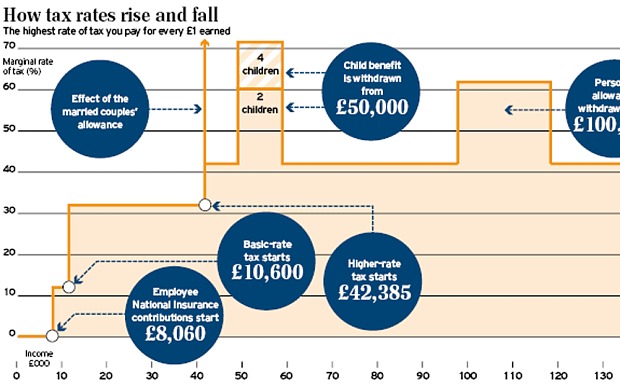
tax_3270762b

So although the headlines focused on raising the tax limit for income tax to above £10,000, it totally ignores the NI contributions payable from £8,060. Although the base rate of tax discussed is said to be 20%, taking into account NI means the lower effective rate of tax that most people pay is actually more than 30%.

We should be honest about this.

Honest. Transparent. Fair.

Income tax in the UK is largely taxed at source, deducted from pay packets before people have access to it and therefore for most people entirely unavoidable. It is essentially a progressive tax which takes a bigger % of income from higher earners. It is therefore also a fairly redistributive system.

It seems unreasonable to charge anyone more in tax than they are able to keep. Something feels unreasonable or unfair about the idea of taxing more than 50% of a person’s efforts but looking at the graphic above, it seems clear that aside from some very minor tweaks when child benefit is taxed and allowances lost, the highest effective rate of tax is just over 40%.

So what would happen if we set the basic rate threshold at £10,000 for the new combined all-income tax (income tax + NI) setting the rate at the current effective level of around 32%? This would be with a view to tweaking the rate up or down once people had got used to the combined all-income tax and the effects could be quantified in practice.

More of the poorest people should be taken out of tax entirely by avoiding NI contributions. Most people would pay slightly more at the lower rate (£600×32%- £192) which would hopefully pay for the lost NI income

And then suppose we leave the higher rate threshold unchanged but set the higher rate of combined all-income tax at 50% ie. higher than the current effective rate of 42% but not gouging. We should abandon all the claw-backs for child benefit and lower tax thresholds. The system would be simpler and easier to understand. It feels honest, transparent and fair.

Although the income tax system is progressive, other taxes are more regressive.

At 20% VAT tends to be more regressive. People on low income have a higher marginal propensity to consume. Therefore, the VAT they pay is a higher % of their total income. People on high income will spend more and will pay more VAT, but they will have a lower marginal propensity to consume (People on high incomes can afford to save a higher % of income). Therefore, VAT will be a smaller % of income spent. The regressive nature of VAT is slightly compensated by the fact that in theory, necessities like food (e.g. cold pastries, cabbages) don’t have VAT. VAT is supposed to be targeted at luxury goods. It’s also worth noting that a significant amount of income received by people on low income comes from the state in the form of benefits.

Other taxes like excise duties on cigarettes and taxes on alcohol are much more regressive. Smoking rates tend to be higher amongst people with lower incomes. Also, it will be a much bigger % of income than for rich smokers. We persuade ourselves that these taxes are for the health benefit of the individuals involved.

We could therefore consider intruding a sugar tax, on similar grounds, that high-sugar foods, especially those targeted at children are bad for their health. This is likely to be highly regressive since obesity is more commonplace amongst people on low income but it’s also likely to be popular with the voting public because of it’s health benefit.

Council Tax, a UK tax on domestic properties, can also be quite regressive and arguably unfair. People living in expensive areas end up having high housing costs, but also a higher council tax band. Arguably a fairer method of collecting local tax would be a local income tax but there are sizeable barriers to implementing any change. the minute a widow is forced out of her large (and expensive) house to pay her tax bill, is the minute a government gets into trouble.

Business rates are the property taxes charged on non-domestic problems and have recently been amended to allow local government to retain 50% amount raised rather than paying into a central pot and having money allocated back.

Inheritance tax raises a relatively small amount of money each year, at around £4.6 million a year but obviously this is in part because of significant tax planning for large scale landowners. The new Duke of Westminster will inherit control of an estate (held in trust) worth in excess of £9billion and pay no tax whatsoever.

It is not the business of the government to encourage the build up of inherited wealth within the hands of the privileged few. Any inheritance should be taxed as a receipt by the beneficiaries in the year in which the gain is realised, as part of the combined all-income tax. For people on low income, an inheritance would be subject to the standard tax bands and rates, treated as a top layer of income.

Since of most people the bulk of any inheritance is property, and the capital gains on houses are not the result of any intrinsic hard work or merit, it seems unreasonable to encourage windfalls for the next generation through any tax system.

It also seems unreasonable to ask the state to fund care in old age in order to preserve any such inheritance for the next generation. Treating any inheritance as windfall income should reduce the temptation to preserve wealth at the expense of paying for a decent standard of living, including care costs in old age.

Another much discussed problem with the UK tax system is the scope for having offshore accounts and avoiding paying tax through tax avoidance schemes.  Tax avoidance is often easier by people with high incomes. Unfortunately it is also perhaps the most expensive problem to address since high income people can afford high fees for good advice.

So my no doubt incredibly unpopular suggestions for change on the “income” side of the puzzle include:

  • Combining Income Tax and National Insurance
  • Set the threshold for basic all-income tax at £10,000
  • Set the tax rate for higher rate tax payers for the new all-income tax at 50%
  • Abolish the various tweaks re: child benefit and removing nil bands
  • Introduce a sugar tax
  • Abolish inheritance tax and treat any inheritance as a windfall to be subject to the all-income tax as a top layer of income.

Not going to happen.

Morning Glory

Every morning this last week, I have woken up, and switched on the news over my first cup of coffee, half expecting to hear that Trump has declared war on N Korea via twitter.

Most recently I heard he had not ruled out military action against Venezuela.

And yet this is a man strangely unwilling to call-out the terrorist actions of a white neo-nazi in America, driving his car into the ranks of anti-racism protestors. Even though he felt no compunction about wading into the furore surrounding a British guy who similarly drove into pedestrians half way across the world in my home city, at around 6am US time.

And since I subscribe to the NYT, I’m struck by the number of comments in a liberal NY newspaper suggesting that someone has to tackle NKorea, sooner or later, so maybe Trump should just go ahead.

Actually, no. No.

There is no benefit to starting a nuclear war early. None

Starting a war with a country as piss poor as N Korea might seem cheap but then you have to take into account it’s neighbour and ally, China. You have to take into account the millions of people living in SKorea who will be killed as a result of Amercian aggression.


Bothered

On one day in June last year, just over half of the people who could be bothered to vote, voted to leave the EU. I voted the other way.

And people voted for all sorts of reasons, but people were not ignorant or stupid, unless they chose to be. There was plenty of information out there. Basically if you believed in the economic argument you voted remain and if anything else was important you voted leave, which essentially meant you voted to leave if “immigration” or “sovereignty” was the important issue.

& it is probably a step too far to say that those voting on the basis of immigration were out and out racists, though clearly a racist argument was made by the leave campaign and people voting for that reason have failed to distance themselves from that argument. But fear of immigrants, of the foreign, is xenophobic at the very least.

& sovereignty is a tricky topic because the word can mean so many different things to different people. At some level it’s tempting to view this as a cleaned up version of immigration ie. control over our borders and anxiety about foreigners. At another maybe it’s anxiety about the role of the EU in setting rules and regulations that apply to the UK, and the relatively low status and lack of respect paid to EU MEPs in this country, a lack of understanding about the UK’s ability to influence and effect change within the EU context and structure.

Either way, if you voted for leave because of immigration or sovereignty, you have been taken for fools. According to government ministers, immigration numbers post-brexit will increase. The government of the day has used the brexit process to attempt a power grab from parliament throughout and continues to undermine and diminish parliamentary sovereignty at every opportunity. The government plans to transfer all EU legislation onto the UK statute book where it will ossify. It takes cross-party support to change, amend or repeal statute and as a consequence the UK government structure is incredibly badly suited to deal with such a huge body of statute.

As time goes by, the EU will amend it’s own laws and the UK has no practical process to amend the legacy laws written onto its books.

No surprise – I believe that brexit will be a disaster for the UK.

But not every brexit platitude can or should be ignored. As the NYT wrote in a recent article, just because it’s something that Trump says, doesn’t mean it’s wrong or trivial.

What brexit issues need to be addressed? Here’s my list:

• immigration needs to be seen to be controlled. Freedom of movement in the EU was never meant or required to be without constraint or limit. People are allowed to move to find work, no more and no less. Foreigner in Belgium who fail to find a job after 3 months are deported. We should do the same. & that would require introducing an ID card and system. It would mean requiring people to register, to show their ID cards before claiming healthcare or welfare. All of this could have been done decades ago and wasn’t because it will inevitably cost more money than it’s worth, but it seems necessary to reassure people that someone somewhere is managing the process.

• The immigration argument is in part racist, in particular feeding off anxiety about uncontrolled immigration from muslim countries such as Turkey, and refugees naturalised elsewhere in the EU making their way to the UK. it’s important to recognise that parts of the Muslim world have a problem with pluralism — gender pluralism, religious pluralism and intellectual pluralism — and suggesting that terrorism has nothing to do with that fact is naïve; countering violent extremism means constructively engaging with Muslim leaders on this issue. It means visible active engagement with everyday Muslim citizens

• The British people want a government focused on growing the economic pie, not just redistributing it. We have a problem with globalisation,  with automation wiping out middle-skilled work and we need to generate more working class jobs to anchor communities. We have a problem with the rise of precarious, short term, high risk employment and the resulting financial insecurity. We have a problem with the concentration of wealth in London and other metropolitan areas, within the Service sector.

The brexit vote was significantly different to the election of Trump in many ways yet similar in one striking fashion: people voted with their emotions in large numbers. Brexit gave many people an opportunity to say loud and clear that they were unhappy with the status quo, whether that meant poverty, the haves and have-nots, or the scale and speed of change within an ever more diverse society.

The UK government needs to re-connect with the electorate. And when you connect with voters, they feel respected, and when they feel respected, they will listen to anything — including big issues that are true even if socialists believe them. Such as the fact that a majority of their children and grandchildren like being Europeans as well as British.


Rotator

The rotator arrived, late, on the Friday and looked like a real beast of a machine. Digging out a new flower bed for roses and iris was always going to be a nightmare and the rotavator was supposed to make that job just a little bit easier.

On Saturday I headed out for some tennis and he decided to give it a go. By the time I got back he was looking sick and dispirited. The bed remained virtually uncut.

It turns out that the kind of rotator that can be hired is a piss poor type of machine when it comes to cutting new ground, especially hard ground. It essentially just skins along the top scratching the turf up but not able to dig or cut into the ground itself. Just holding the beast was difficult. Forcing it down into rock hard turf was impossible.

The beats was retired and we proceeded to dig the bed the old fashioned way with fork and spade. It was hard and horrid work but more or less complete by the end of the weekend. The initial scripting of turf means the bed is full of grass remains so even though it’s now covered up and hopefully rotting down, it will clearly keep appearing in the bed for years to come.

Ho hum.

We’ll plant up in September/October and see how things grow.

Better

Hundreds of children, including some as young as five, are being expelled or temporarily excluded from school for sexual misconduct including abuse, assault, harassment and watching pornography, according to new figures.

The research reveals that pupils are being disciplined for a wide range of incidents described as sexual misconduct, including bullying and “lewd” behaviour, as well as sharing indecent images on social media.

Figures obtained via a freedom of information request by the Press Association from 15 local authorities found 754 children had been expelled or temporarily excluded from school as a result of sexual misconduct in the past four years.

And this is after a damning report produced for parliament on sexual harassment and violence in schools last year.

& whilst no doubt there are many downsides to sending my kids to single sex schools, I am very glad to have missed this shit.

UK Government report Conclusions:

1.Sexual harassment and sexual violence in schools is a significant issue which affects a large number of children and young people, particularly girls, across the country. Evidence shows that the majority of perpetrators of this abuse are boys, and the majority of victims are girls. However it is essential that the negative impact on both boys and girls is recognised and addressed.

2.There is insufficient data to conclusively demonstrate that sexual harassment and sexual violence in schools is a growing problem. It is true that such behaviour has occurred in schools for many years, as in wider society. However, significant qualitative evidence suggests that increasing access to pornography and technological advances, including online platforms, can facilitate harassment and violence and thus exacerbate the problem.

3.Teachers, parents, young people and third sector organisations are telling us that sexual harassment and sexual violence in schools is having an impact on young people and school life. Consequences include: physical and emotional harm, including teenage pregnancy and sexually transmitted diseases; girls feeling unable to fully participate in educational and extra-curricular opportunities; teachers spending valuable time dealing with incidents of sexual harassment and bullying; and young people developing a sense that sexual harassment and sexual violence are acceptable behaviours and learning social norms that are carried through to adult life.

4.The Government and schools must make tackling sexual harassment and sexual violence an immediate policy priority.

5.Schools lack the guidance, training and structures to deal with incidents of sexual harassment and sexual violence. Too often such incidents are brushed aside by staff and not taken sufficiently seriously by school leaders.

6.We welcome the new sexting guidance for schools. However, guidance on specific areas of harassment is not sufficient to deal with sexual harassment and sexual violence in schools.

7.We welcome the fact that the Government has committed to further amending Keeping Children Safe in Education guidance. We are also encouraged that the Government has said the Committee may be able to feed into this. However, it is disappointing that it has taken this inquiry for the Government to address sexual harassment and sexual violence in schools within this key piece of statutory guidance.

8.We recommend that Keeping Children Safe in Education should directly reference sexual harassment and sexual violence. It should refer schools to a whole school approach as the most effective means of tackling this problem. Specialists working in the field of sexual harassment and violence against women and girls should be consulted on the best ways to draft these revisions to KCSIE.

9.There is no reason why sexual harassment should not be included alongside racist, homophobic and disability-based bullying in Ofsted or Government guidance. We welcome the Minister’s commitment to raising this issue with Ofsted and look forward to both Ofsted and the Government’s guidance being amended urgently.

10.Ofsted and Government guidance on bullying should be amended immediately to include direct reference to sexual harassment and resources for how to deal with it. 

11.There is overwhelming evidence that schools want, and need, clear national guidance on how to tackle sexual harassment and sexual violence. We agree that different schools may wish to tackle the problem of sexual harassment and sexual violence in different ways. It is also important that, whilst all schools must meet national standards, they should be encouraged to surpass these expectations whenever possible.

12.Sexual harassment and sexual violence in schools will only be reduced through a whole school approach. This must involve all staff, students, governors and parents, in addition to local child safeguarding bodies, police and specialist third sector organisations. Schools need guidance on how to implement this approach effectively. The Welsh Government offers a useful model for how this can be achieved.

13.The Department for Education should develop, publish and publicise national guidance on adopting a whole school approach to reducing and preventing sexual harassment and sexual violence in all primary and secondary schools. This guidance should be published so schools can implement it in September 2017.

14.It is clear that, in addition to amending current guidance, new legislation is needed to ensure tackling sexual harassment and sexual violence becomes a priority for all schools.

15.The Government should create a statutory obligation in the forthcoming Education Bill for all schools, primary and secondary, to develop a whole school approach to preventing and tackling sexual harassment and sexual violence. We also recommend that the Department for Education remind all school Governors of their legal obligations to address sexual harassment and sexual violence in school. Guidance and support on how to achieve this most effectively should be provided to Governing Bodies.

16.We recommend that police data record the incidence of sexual harassment and sexual violence in schools specifically. This would allow forbetter analysis of the prevalence and increase/decrease of this problem.

17.Understanding the scale, location and relative incidence of sexual harassment and sexual violence in schools is key to addressing it. However, current data collection has been shown to be inadequate. Schools need better guidance on what constitutes sexual harassment and sexual violence; and how incidents should be recorded and reported. There is scope for improved cooperation between schools and other agencies, like the police, working in this area.

18.As part of the whole school approach guidance we have recommended, the Government should ensure all schools receive clear definitions of what constitutes sexual harassment and sexual violence. Schools also need information on how to record, monitor and respond to incidents, including when to report them to the police. All schools should collect this data. It should be collated nationally and published annually.

19.We agree with the majority of experts we heard from that Ofsted should be monitoring State-funded schools’ actions in preventing and tackling sexual harassment and sexual violence and supporting survivors. It is already tasked with inspecting how adequately schools are safeguarding pupils and has a well-established school inspection regime in place.

20.In order for Ofsted to successfully monitor schools’ progress in this area, it must update its training and guidance by September 2017 so all schools are inspected on how effectively they are preventing and dealing with sexual harassment and sexual violence.

21.We welcome the new standards the Government has implemented for safeguarding children’s welfare in independent schools. However, these changes do not directly address the continuum of sexual harassment and sexual violence in schools.

22.The obligation on schools to prevent and address sexual harassment and sexual violence that we called for must include independent schools. 

23.Good quality SRE is shown to have a positive impact, helping to reduce sexual harassment and sexual violence. The evidence clearly shows that current provision of education in this area is patchy and largely inadequate.

24.By the time they reach secondary school children often have entrenched views about gender norms. It is therefore important that children are educated about gender equality, consent, relationships and sex in an age appropriate way starting in primary school.

25.Excellent resources to teach children and young people about gender equality, relationships, sex and consent, in age appropriate ways, already exist. But at the moment only a minority of schools are delivering good teaching in this area. The Government must take a lead in ensuring that all children have access to high quality SRE and it does not remain the privilege of a few. Making SRE a statutory subject is the first step towards achieving this. The vast majority of parents, pupils and teachers support statutory PSHE/SRE, as do health professionals, the police and other experts working in the field.

26.We welcome the Government’s response that the status of PSHE and SRE is currently under review.

27.We recommend that PSHE and SRE are made statutory subjects as part of the new Education Bill. 

28.There is a clear need and desire for better training to support teachers, other school staff and Governors to address the issue of sexual harassment and sexual violence, both in SRE and through a whole school approach.

29.As part of its ongoing review of Initial Teacher Training, we recommend that the Government assess the most effective ways to ensure all school staff are well trained to deal with and prevent sexual harassment and sexual violence. The Government should report back to us with their findings and plan of action by March 2017.

30.Too often, SRE ignores the position of boys and young men. It must be broadened to challenge harmful notions of masculinity and reflect boys’ experiences. It should also support boys to challenge and reduce sexual harassment and sexual violence.

31.We welcome the Government’s interest in supporting boys and young men to be part of the solution to the problem of sexual harassment and sexual violence. We recommend that the Government fund research to establish the most effective ways to achieve this.

32.Parents have an important role to play in reducing levels of sexual harassment and sexual violence. Taking a whole school approach to this problem will mean parents are fully engaged and supported to address the issue with their children.

33.Specialist sector organisations play an important role in delivering high quality SRE, as well as supporting schools and pupils when disclosures about sexual harassment and sexual violence are made. It is essential that these organisations are able access adequate resources so they can continue to support schools and young people.

34.The Government should create a fund to support specialist sector organisations to use their expertise to help schools tackle sexual harassment and sexual violence.

35.Widespread access to pornography appears to be having a negative impact on children and young people’s perceptions of sex, relationships and consent. There is evidence of a correlation between children’s regular viewing of pornography and harmful behaviours. The type of pornography many children are exposed to is often more extreme than adults realise.

36.Current Government guidance on teaching SRE was last updated 16 years ago and has no reference to pornography. There is a clear need for better guidance to schools on how to approach this sensitive topic in an age appropriate manner.

37.The Government should immediately update its guidance on SRE to include teaching about pornography. The new guidance should offeradvice to schools about how to approach this topic in an age appropriate way. It should also include suggestions of how schools can work in partnership with parents to address the impact of pornography on children’s perceptions of sex, relationships and consent. 

38.We welcome the Government’s forthcoming legislation for age verification of pornographic websites. However, age verification legislation will only contribute to reducing sexual harassment and sexual violence in conjunction with the other recommendations made throughout this report.

Gard

The heartbreaking story of an 11-month-old baby boy, Charlie Gard, has dominated newspaper headlines in the UK, and more widely. In th last few weeks, Charlie’s parents, Connie Yates and Chris Gard, ended their legal fight to transfer their son to the USA for experimental treatment. After further court hearings to decide where Charlie should die, he was transferred to a children’s hospice. On July 28, Charlie died.

Reflections on why decisions about Charlie’s care ended up being made in court are important. Fundamentally, it was because no agreement could be reached between his parents and his clinical team. Charlie had a rare form of encephalomyopathic mitochondrial DNA depletion syndrome and was a patient in Great Ormond Street Hospital (GOSH).

There is no proven treatment for his disorder.

For most of his short life, Charlie was ventilated in the intensive care unit and in December, he began to have severe seizures. The GOSH team concluded that his brain damage was severe, and that his life support should be switched off. But Charlie’s parents disagreed, saying that he did not have irreversible brain damage and that he was able to respond to their touch.

With no agreement between his parents and his clinicians, GOSH applied to the High Court, and, on April 11, Mr Justice Francis ruled that it was in Charlie’s best interests to stop life support. Charlie’s parents then lost their appeal against the judgment, and pursued their fight in the Supreme Court, then in the European Court of Human Rights, to no avail.

In July, Pope Francis and President Trump offered support to Charlie’s parents. The doctor who had offered to give nucleoside treatment to Charlie in New York reviewed the case details and retracted his offer.

Meanwhile, staff at GOSH, their families, and Charlie’s parents all received abuse and threats.

At the heart of this sad story is a breakdown of trust and communication between Charlie’s parents and the clinical team at GOSH, but also fundamental disagreement over the extent of Charlie’s brain damage, and about who has the right to make decisions about his care. Since February, GOSH‘s position has been that every day that passed was a day that was not in Charlie’s best interests.

For Charlie’s parents, however, hope (perhaps given in vain) and love sustained their fight for their son. They believe that had their son received the experimental treatment sooner, he would have had a chance.

Overseas, the Gard case has been portrayed as a fight between parental rights and the State, yet that is to fundamentally misunderstand the legal argument. In the UK, parent’s don’t have rights, so much as they have responsibilities. The rights of the child must always come first and foremost. GOSH, the UK courts and the European Courts had all decided it was in the child’s best interest to allow him to die.

When the limits of medicine are reached, communicating those limits to parents falls to paediatricians or intensivists, and is undeniably difficult to do. Clinical decisions are rarely black or white, and communicating the shades of grey can be extraordinarily difficult, especially when a baby is involved. Finding the right time and place, allowing time to reflect, ask questions, and revisit the conversation are all essential, and it is a hard skill to learn. The level of pain and suffering, and whether any treatment can prolong life, has to be taken into account.

Faith-based considerations might be important to discuss, especially if either parent holds a strong religious point of view. Usually, agreement can be reached, and it is rare that lack of consensus ends with a court application.

Mediation between all parties might be valuable to consider as a step before coming to court, and the Judge in Charlie’s case suggested it should be compulsory, although at times it too may fail. The overriding principle in UK law is to consider what is in the best interests of the baby; this is not the case in all countries.

When no treatment for a disease exists, Dominic Wilkinson and Julian Savulescu in a Comment in this issue propose an ethical framework for deciding on access to experimental treatment. However, clinicians should avoid giving false hope. “The child first and always”, GOSH’s slogan, has to be at the heart of clinical decision making.

Amid the grief and sadness, there is, however, a value, indeed a need, to stand back and think about what we can learn. Consider a slightly different case:

A boy had suffered a catastrophic injury while being operated on: his neck had been broken. Though alert and talkative, he was paralysed. His parents had told his doctors that they wanted care to be withdrawn (he was on a ventilator) so that he could die peacefully. He wasn’t terminally ill, but they thought it best given what the future would hold.

Assume no precedent. What would your advice be? It seems clear that as a minimum, the parents’ views should not be the last word; the lawyers should go to court, ensure that the child was separately represented by a lawyer, and that the only question for the court was what was in the child’s best interests. The advice was followed in a NZ case. The child was made a ward of court, was cared for and lived on.

I’m sure that those who have involved themselves in the case of Charlie Gardwould applaud what happened in Auckland. But if they do, they would also have to acknowledge a number of things that have been part of our approach to the care of children since the 19th century. The first is the most fundamental: as a society, we must choose how to decide such heartbreaking cases. Of course each child is different, but do we accept that there should be principles and rules, whatever the circumstances, that guide us as we try to work out what’s best?

We can, of course, reject such a view and choose to go with the heart and emotions. But if we do, whose heart should prevail when there are conflicting views? Where there is conflict, how do you resolve it? Alternatively, we can reason our way through, cold as this may appear. We can accept the idea of principles and rules. And, if reason is to prevail, you need to analyse how to proceed.

These are the steps. The first is to recognise that children do not belong to their parents. Second, when a claim is made that parents have rights over their children, it is important to step back and examine the language used. We need to remind ourselves that parents do not have rights regarding their children, they only have duties, the principle duty being to act in their children’s best interests. This has been part of the fabric of UK law and society for a long time. Third, if we are concerned with the language of rights, it is, of course, children who have rights; any rights that parents have exist only to protect their children’s rights.

Now, in giving effect to a child’s rights, the parents’ views as to their children’s interests should usually be respected. But parents cannot always be the ultimate arbiters of their children’s interests. If parents, for example, insist on subjecting their child to a particular diet that, in the view of others with acknowledged expertise in the subject, will cause the child harm, we do not stand by. We intervene to safeguard the child.

When such concerns arise, there has to be a mechanism to decide the circumstances in which parents’ views should not prevail. That mechanism has to be a trustworthy and independent source of authority, sometimes a local authority, but ultimately, as ever in a civic society, a court. The court’s sole concern must be, can only be, for the child and the child’s interests. Evidence and views, particularly those of the parents, must be listened to. The court must then decide and, crucially, make its decision and reasoning public, exposing it to scrutiny and holding it to account. The court is not infallible. That’s why we allow for appeals; a kind of second thought. But, ultimately, we are not in the realm of there being a right answer. We are in the realm of judgment, reasoned judgment, and we look to the courts to provide this.

This process depends of course on acceptance of the supremacy of reasoned argument over passion and the acceptance of the independence and authority of the courts. Campaigns against the courts, whether led by tabloid newspapers, organised through social media or exploited by sectional and religious groups, are increasingly a feature of modern discourse. It is one thing to comment on or criticise a particular decision. It is a very different thing to attack the institution of the courts.

Here, in Charlie Gard’s case, the call has been to keep the courts out; they don’t understand. Only the parents should decide: let passion prevail. Those behind such calls should reflect on what they wish for in case they get it. A whole system designed to address dispassionately the rights and interests of children would be pushed aside. And perhaps they should think of that little boy in NZ.

June/July Garden

All is chaos and I kind of like it that way at the moment. The garden is at a tipping point whereby any moment now it’s going to flip from beautiful to drunk and disorderly planting.

And in the midst of all the planting misdemeanours are some very welcome  and very calm foliage plants like the ferns and fatsia.


Truth be told I’m a bit unconvinced by the latter and am trying to sell myself on the idea. having painted the tubs up and planted them with the variegated brutes it would seem a bit defeatist to admit they’re a bit, well, a bit “meh”

I shall persevere with the shady block at the back, despite the geranium overrun.

Shady Chaos
Fatsia

And hope for a wetter year next year to help build some colour to go with the annuals (begonias) in pots.

The new roses are lovely, but follow the sun so face towards the house and away from the lawn and swing seat behind. It’s a small point, but they’ll have to grow for a couple more years before we really get to see them above the lavender.

David Austin Roses

They’ve been underplanted with geranium rozanne which is also going to take a few years to get going.

Plus a few plants shoved in rather carelessly that have not worked especially well, some gladioli and a leftover salvia.

Gladioli nanus

The silver leaf is a survivor from one of my disappointing baskets. If the plant shows some sticking power, I find it difficult to throw it away but of course it means a garden full of unruly thugs.

Not dead yet hanging baskets

Thanks to some watering the baskets are definitely doing better the year, not beautiful but still alive at least. Best of all the tiny bed on top of the railway sleepers has also picked up.

Along with some overly planted pots. Thank goodness begonias are so forgiving.

Begonia stalwarts
Busy borders

This is the month that the penstemons come into their own, even the aptly named sour grapes.

Friedrich am Denken

And down on the side, the old roses are also doing well for having been cut and taken inside for flowers on a regular basis.

Silver Leaf
Perenial Geranium Rozanne

Some of the plants seem to have been flowering forever and are still full of joy.

Perenial Wallflower

The bees are happy and so am I with flowers everywhere and not too many weeds.


Up in the gravel, the story is all about flowering sedums of one sort or another.

Flowering sedum

Plus the indestructible fleabane. Because of the dry, I look set to lose a few plants, hopefully not too many.

Mexican fleabane

But just as I think I’ve lost them, it rains and one pops up as a survivor.

Verbena Bonariensis Lollipop

One day maybe I’ll know what I’m supposed to do with all of this, but not quite yet.


Genie

Scientists have, for the first time, corrected a disease-causing mutation in early stage human embryos with gene editing. The technique, which uses the CRISPR-Cas9 system, corrected the mutation for a heart condition at the earliest stage of embryonic development so that the defect would not be passed on to future generations.

The work, which is described in Nature on August 2, 2017, is a collaboration between the Salk Institute, Oregon Health and Science University (OHSU) and Korea’s Institute for Basic Science and could pave the way for improved in vitro fertilization (IVF) outcomes as well as eventual cures for some of the thousands of diseases caused by mutations in single genes.

Though gene-editing tools have the power to potentially cure a number of diseases, scientists have proceeded cautiously, in part to avoid introducing unintended mutations into the germ line (cells that become eggs or sperm). The research in the current study adheres closely to guidelines established by OHSU’s Institutional Review Board and additional ad-hoc committees set up for scientific and ethical review.

Hypertrophic cardiomyopathy (HCM) is the most common cause of sudden death in otherwise healthy young athletes, and affects approximately 1 in 500 people overall. It is caused by a dominant mutation in the MYBPC3 gene, but often goes undetected until it is too late. Since people with a mutant copy of the MYBPC3 gene have a 50 percent chance of passing it on to their own children, having two genetic strands one faulty one not, being able to correct the mutation in embryos would prevent the disease not only in affected children, but also in their descendants.

The researchers generated induced pluripotent stem cells from a skin biopsy donated by a male with HCM and developed a gene-editing strategy based on CRISPR-Cas9 that would specifically target the mutated copy of the MYBPC3 gene for repair. The targeted mutated MYBPC3 gene was cut by the Cas9 enzyme, allowing the donor’s cells’ own DNA-repair mechanisms to fix the mutation during the next round of cell division by using either a synthetic DNA sequence or the non-mutated copy of MYBPC3 gene as a template.

Using IVF techniques, the researchers injected the best-performing gene-editing components into healthy donor eggs newly fertilized with the donor’s sperm. They also tried a second method, introducing the gene editing components along with sperm into the egg prior to fertilisation.Then they analyzed all the cells in the early embryos at single-cell resolution to see how effectively the mutation was repaired.

The scientists were surprised by just how safe and efficient the method was using the second method ie. introducing the gene editor and the sperm prior to fertilisation and allowing the embryonic repair and replication process to identify the faulty gene as early as possible.

Not only did a high percentage of embryonic cells get repaired, but also gene correction didn’t induce any detectable off-target mutations and genome instability — major concerns for gene editing. In addition, the researchers developed a robust strategy to ensure the repair occurred consistently in all the cells of the embryo. (Spotty repairs can lead to some cells continuing to carry the mutation.)

“Even though the success rate in patient cells cultured in a dish was low, we saw that the gene correction seems to be very robust in embryos of which one copy of the MYBPC3 gene is mutated,” says Jun Wu, a Salk staff scientist and one of the paper’s first authors. This was in part because, after CRISPR-Cas9 mediated enzymatic cutting of the mutated gene copy, the embryo initiated its own repairs. Instead of using the provided synthetic DNA template, the team found, surprisingly, that the embryo preferentially used the available healthy copy of the gene to repair the mutated part. “Our technology successfully repairs the disease-causing gene mutation by taking advantage of a DNA repair response unique to early embryos” says Wu.

Izpisua Belmonte and Wu emphasize that, although promising, these are very preliminary results and more research will need to be done to ensure no unintended effects occur.

“Our results demonstrate the great potential of embryonic gene editing, but we must continue to realistically assess the risks as well as the benefits,” adds Izpisua Belmonte.

Future work will continue to assess the safety and effectiveness of the procedure and efficacy of the technique with other mutations.

And reactions to the story in various newspaper seem to split into two basic camps: “this is brilliant, science at it’s best, leading us towards a glorious future that only primitives could disagree with” versus “this is satan’s work”.

It seems to me that the people so quick to condemn the doubters, are actually a bit naive about science and its often flawed nature. We are a long way away from any tangible good coming from this experiment and the ethical and moral questions it raises are considerable; something pointedly acknowledged by the scientists involved. An easier and quicker way to screen for this genetic disease would be to scan the sperm and filter out the faulty before using the healthy sperm to fertilise healthy eggs. Being able to cut and paste sperm in a petri dish, as opposed to sifting them to exclude the damaged,is an interesting intellectual exercise rather than a practical one.

The success rate when editing the faulty sperm prior to fertilisation was low. The scientists involved do not understand why or how the embryonic repair function works the way it does or indeed why it was so successful in choosing a healthy non-mutated copy of the gene as a template in replication.It may simply be that the genetic scissors attaches itself to the faulty gene and renders it somehow visible (and undesirable) to the embryonic replication system ie. the process was identifying and rejecting artificial intervention anywhere rather than anything more positive.

A surprising number of positive comments failed to distinguish between normal medical intervention, antibiotics, surgery, vaccination etc and genetic alteration that changes subsequent generations. A number seemed entirely content to compare gene editing with dog breeding, seemingly unaware of the obvious unintended yet damaging health implications in any number of dog breeds. The most fervent of supporters for the new research seemed surprisingly religious in their beliefs, with really a minimum of understanding and an awful lot of faith on display.

I have no patience with the idea that new scientific research is the work of the devil but I feel a bit uneasy about this messing about with our genetic heritage. We still know so very very little about how our genetic material interacts and operates that it seems inevitable that there will be some unintended consequences once we start messing about. I’m not so much fearful of deliberate malicious intervention, as I am of accidents where a scientist manages to fix problem (A) and three generations later we find that the IQ of a population drops 10 points, or that problem (A) also switched on some reaction in the immune system that would have allowed us to live an extra ten years without dementia.

It’s the unintended accident that worries me rather than the happy accident that this experiment seems to have discovered.

Inconvenient truths

A recent piece of research has broken down the expected impact of brexit by industry sector and by political constituency (http://cep.lse.ac.uk/pubs/download/brexit10.pdf). Not surprisingly the economic impact is negative, no matter where you live and no matter what type of brexit. The economic argument has always been clear.

People who voted ‘leave” voted for other reasons.

And yet whatever those reasons were, they seem doomed to disappointment. We were told that the main reasons given for voting leave were “immigration” and “sovereignty” with a vague suggestion of “control” coming in as well.

Let’s assume that immigration may or may not be related to dog-whistle racism. Let’s assume that “control” means control over the numbers of immigrants entering the country or control over the laws enacted within the UK. Will this brexit deliver what these voters have asked for?

Start with the basic fact that most immigrants to the UK are not from the EU. Most immigrants enter on visas from outside of the EU, either work visas or student visas. This matters because research has shown that in fact the voters of the UK vastly prefer EU ie. white immigrants to non-EU immigrants, though ‘leave” campaigners vigorously deny racism (http://blogs.lse.ac.uk/brexit/2017/06/05/uk-voters-including-leavers-care-more-about-reducing-non-eu-than-eu-migration/)

The long term net migration for non-EU migrants is around  175,000 according to the ONS (https://www.ons.gov.uk/peoplepopulationandcommunity/populationandmigration/internationalmigration/bulletins/migrationstatisticsquarterlyreport/may2017) which makes a mockery of the Tory “target to reduce all net migration to the tens of thousands.

Any proposed immigration controls currently being suggested by the government, were ones available within the EU anyway. EU freedom of movement has always been in service of work and industry. An example might be Belgium’s immigration practice of deporting any EU citizen who hasn’t found a job within three months – all perfectly consistent with the EU rules.

The ONS figures see a fall in the rate of immigration, largely because EU nationals have started returning to their country of origin and fewer are arriving in the UK to take up jobs. It seems likely that a reduction in the increase of immigrants will continue, but that the overall number of immigrants here will still increase i.e. if people voted leave to reduce the number of immigrants they will be disappointed. They have been taken for fools.

So what about those people voting to ‘leave” the EU on the basis of sovereignty? Interestingly the recent Conservative White Paper makes clear that sovereign power has always resided within the UK. The arguments over exercising Article 50, have largely been one of sovereignty, where the government has sought to undermine parliament and grab power for the executive, suggesting that if anything the brexit process could have led to a reduction in parliamentary sovereignty without the intervention of the judicial system. That argument continues with the parliamentary tussle over executive powers when drafting the upcoming Repeal Bill.

Aside from being an incredible example of double-speak (what kind of repeal involves taking each and every part of EU legislation onto British statute books?) there is considerable anxiety within parliament at the scope of cut and paste required to complete the stated objective of this piece of legislation, plus a real sense of distrust that maybe, the government will take this opportunity to change the law rather than just transfer it by perhaps deliberately forgetting to transfer key pieces of protective legislation around workers rights, environmental protections etc.

Let us assume that the government sets out to do exactly what has been described. No one actually knows the extent of legislation that the EU has passed and it’s implications for the UK statute book, because no one has ket a record, There was never thought to be a need. So there is a very real risk that pieces will be left out by accident, and will only be identified when something goes wrong down the line, requiring the attention of the courts and possibly parliament to rectify.

Let’s assume that the UK government, despite the logistical hurdles, manages to transfer each and every piece of EU law onto our own statute book. Does that give us sovereignty in any meaningful sense?

In order to change statute, there must be cross-party support, unless the government of the day has a stunningly large majority and consensus on the topic. The chances of this happening on significant EU legislation are vanishingly small. The UK has always been and will always be, really really bad at revising statute. So actually taking this law onto our own statute book makes it practically impossible to change any of it.

Furthermore if we want to continue to trade with the EU, and as our single largest trading partner we’d be stupid not to, then each and every piece of ew legislation relating to trade etc. will have to be implemented on our own statute book. Leaving the EU has gained us nothing in terms of EU law and regulation so anyone voting “leave” for those reasons should be gutted. They have been taken for fools.

But what about non-EU trade? Well, the Foreign Office are currently looking at our independent WTO trade schedule which will need to be ratified by all members of the WTO once we formally cut our ties to the EU. In order to make this work practically, the FO have decided to copy the EU trade schedule that we currently use, word for word, clause for clause. This is the only practical way to ensure that the other countries sign-off without dispute. So no change, no sovereign gain to be made there.

What about post-brexit, surely we will be able to change our trading schedule as we like? Well, maybe. We’ll be able to try to change the schedule, but each change will need to be signed off by all of the other members including the EU, and to be frank, there are political limitations to what can be achieved without trade-offs. Argentina might decide to cut-up rough about the Falkland island. Spain and the EU might decide to cut up rough about Gibraltar etc. All the practical reasons for adopting the EU trade schedule initially will remain in place making any changes difficult.

But surely we will be able to negotiate trade deals with other countries more easily? Maybe. But the first priority will have to be renegotiating the 50 or so trade deals that the EU has negotiated already with countries such as S Korea, Canada, Japan etc. and that we will no longer benefit from. Any suggestions that brexit might benefit UK trade with the developing world, Africa etc. failed to take into account the damage done by the UK stepping outside of EFTA when it leaves the EU.  Any benefit from a US deal, a newly protectionist US under Trump,  is likely to be offset with damaging concessions within the UK agricultural sector and health sector.

The political reality of becoming a small country once more, one trying to negotiate with much larger countries, is likely to be sobering politically. We may be more noble politically speaking but we will be playing catch up. At a basic level we will be trying to rebuild a negotiating team that we have long outsourced to the EU. We will be trying to catch-up with new deal with those countries whose trade deals we have lost with our EU membership. We be trying not to be pushed around by the sharks, despite our new status as a minnow.

Anyone voting “leave” for reasons of non-EU trading relationships is going to be facing some stark realities for the next decade or so.

Yet when engaging in conversations around brexit, there are plenty of “leave” voters still cheering. When faced with the argument that their reason for voting just isn’t going to be realised, most fall silent. Some retreat to other reasons such as “yes, but … fishing”

The problem is there is an obvious economic rebuttal to be made for each and every alternative (including Fisheries: 80% of the UK catch is sold into the EU and will be subject to tariffs).

But obviously people din’t vote leave because of the economy, they voted leave despite it, partly maybe because they didn’t believe in the predictions but also maybe because they didn’t believe that their local economy could get any worse.

As the regional breakdown of the expected impact of brexit shows, they’re about to find out how wrong that could turn out for them. The greatest impact of brexit will be felt in areas that voted remain, but in many ways those areas are also the wealthiest and also therefore best placed to cope with the downturn. Those areas voting “leave” will be impacted less, but will still lose 1-2% of their economy as a result of brexit. Since the UK as a whole will lose out more, the chances of regional or trade sector grants and allowances being maintained seem slim, so poorer areas dependent on regional regeneration grants, or subsidised sectors such as agriculture, fisheries etc. will be hit hard.

Ho hum. However you voted in the brexit referendum, you are not getting what you voted for. People who voted remain are just the ones who found out first.