Have you checked the data Facebook is holding about you? As a not very diligent user of social media, I finally got around to taking a look. Obviously it has a record of all of your posts, photos and videos & obviously it keeps all of the self-declared interests in music etc.
I was not surprised by the lack of contact information from my mobile phone or email because I can remember thinking “Not in a month of Sundays” when asked setting up the account. Some people have their entire address book stored plus a record of every phone call including the data saying where, when etc.
That’s a bit too spooky big brother for me!
I was freaked out enough by finding unexpected advertisers and installed applications.
All in all, I’ve managed to contain the data held on me to a reasonable level mainly by being paranoid at set-up and not much of a user thereafter.
But I would certainly advise anyone to take a look at the data held on them (via settings). If you’re not happy then delete (not disable) the account to remove the data and then set it up again with a bit more care about the settings.
How do you decide what to cook for guests for supper?
We have two couples coming over for supper, a very English middle-class way of saying “dinner” with pretensions. One includes a south American with a taste for spice, whilst the other includes a man with an Indian mother. I am not going anywhere near cooking an Indian dish that his mother inevitably makes better. But I do fancy a bit of spice and at this time of year, crisp and cold weather suggests warming soups and stews.
I’m veering towards a butternut laksa dish, smooth coconut and comfort personified. It has a bit of heat but all wrapped up in a creamy buffer. The “soup” can be made a long time in advance with the butternut squash cooked ahead and added last minute, just to warm through. It has south east asian overtones but I’ll probably cook basmati as an accompaniment – there’s something incredibly reassuring about a rice that you can essentially add boiling water, cover with a lid and leave to its own devices for 10 minutes.
Once you’ve decided the central dish, the rest sort of looks after itself. I’ll make a side dish of spinach and coconut which is basically from an Indian cook book but goes so well with the laksa that no one will care. Again, the spice mix can be made ahead of time, and the spinach microwaved, so all that’s required is a quick stir fry just before serving.
And for desert I’m going to serve rhubarb and lychees in warm syrup with vanilla ice cream – make ahead and just heat through last minute.
But every meal should have some fiddly bits, so maybe I’ll add some chilli aubergine. Because the aubergine is deep fried, and my deep fat fryer is tiny, it will take quite a bit of time to fry the aubergine in batches. Once cooked, it can be served as it is or on a bed of noodles (is this too much with rice already on the table?)
I have korean chilli crackers for snacks and could knock up some kale crisps as well. The latter would make a decent garnish for the laksa.
But since I have a small hob and limited pans, the main question is whether I can fit everything on to cook.
Skillet- laksa
large saucepan – rhubarb and lychees (left to the side until after the main meal then warmed through)
medium saucepan – rice
small saucepan – aubergine chilli sauce/noodles if required
wok – spinach and coconut
And probably the trick to make it look decent is to have a number of garnishes pre-prepared at the side of the kitchen, so small sliced chillies, coriander leaf etc.
Is there anyone alive today in the UK who is not absolutely sick to the teeth of brexit, and with no sign of an end, or even the beginning of the end in sight. And yet there is no escape from recurrent lies.
Yet again, Boris Johnson brings out of the cupboard the idea that we can save ourselves £350m a week or £18bn a year once we’re out of the EU and spend that money on the NHS instead.
Yet again, responsible people point out that this is a lie, that there is no truth to the £18bn figure and once again a group of plonkers in on-line forums says, “Yes, but…” and happily repeats the figure as if it were true.
Repeating it doesn’t make it true. Pointing out that people are just telling lies, surely they must know by now that there is no truth to the figure, just seems to make them double down.
They seem to just not understand the numbers, any numbers:
The £5bn rebate is never paid to Brussels ie. of the £18bn gross figure you are mis-quoting, £5bn stays in the UK and is spent (or not) entirely at the discretion of the UK government.
Of the actual payment to the EU, the £13bn net figure paid to Europe, an additional £4.4bn is paid back to the UK in the form of agricultural payments etc.
& also in addition £1.4bn more is paid back to the UK in terms of payments to universities etc in the form of scientific research
& on top of that, the EU pays £1bn in lieu of us paying our foreign aid commitments directly.
The net payment to the EU is around £7-8bn. which fades into insignificance compared to our trade with the EU.
& if people want to talk about trade with the EU versus opening up of supposed trade outside of the EU, then in addition to direct UK-EU trade, people really should take into account the loss of around 70 free trade agreements negotiated by the EU that we disappear when we leave with the likes of Canada, S Korea etc plus the free trade agreements in the pipeline with Japan etc.
None of this is rocket science or even remotely contested.
Why can’t people just cope with the facts as they are rather than telling lies? It is the stupidity that grates most in the end. There is no economic argument for leaving the EU; there just isn’t one to be made.
You could make other (I believe fatuous) arguments around sovereignty and the obviously xenophobic, most likely racist argument against immigration made primarily by people living in areas of low to no immigration.
But there is no economic argument that stands any scrutiny whatsoever. You won – get over it.
I am increasingly pessimistic about the brexit options for Ireland.
In December the UK government conceded that there were no technological solutions currently available to allow for a soft border within Ireland and under pressure from the DUP it agreed with the EU to “regulatory alignment”. It was a fudge of course because the meaning was never clearly defined but it allowed both parties to move forwards towards trade talks.
However. the UK cannot get a legally watertight transition deal until it resolves the status of the Irish border as part of a wider divorce settlement with the EU, sources have said, as brexit talks move into an intense phase.
Senior UK and EU officials are due to meet this weekend in Brussels, ahead of an EU27 Brexit summit on Friday, when Theresa May hopes to bag the transition deal that UK business requires.
But firms will be denied certainty on the transition deal, as EU sources stress the best the UK can get in March is a political text, not a legally binding treaty giving cast-iron security for companies across Europe.
The EU have published a position paper that suggests as a fall back option setting a hard border between N Ireland and the rest of the UK, allowing N Ireland ‘special status” within the EU. Whilst certainly a practical alternative, the proposal is toxic to the Irish DUP as they see it as a stepping stone towards a re-unification of Ireland. Since the UK government is a minority government reliant upon the votes of the DUP to pass any legislation, this makes the “fall-back” option impossible to contemplate.
But no alternative has been proposed by the UK.
Let’s be clear, this is a problem that the UK have created and therefore it is the responsibility of the UK to come up with a workable solution.
The UK has voted to leave the EU in the referendum. The UK government has taken that a step or two further and decided to leave both the single market and customs union. The UK government has chosen to become a third party country. WTO rules require all third party countries to be treated on the same terms, without preference so when the UK leaves, it becomes a WTO requirement to have a hard border in Ireland unless we achieve the “holy grail” of a comprehensive free trade agreement.
Given a choice between a hard border within Ireland and one between N Ireland and the rest of the UK, it is likely that the DUP would opt for the latter despite the disastrous economic consequences for their electorate. One in three adults in N Ireland are already unemployed. A 10-20% hit to their economy resulting from a closed border would lead to a further loss of jobs. Add economic deprivation to a sectarian divide with such a recent history of violence, then the situation looks anything but good.
The alternatives, which would include Labour policy of keeping the entire UK within a customs union with the EU, effectively remove any chance of independent trade deals outside of the EU, seem equally unlikely unless the government falls and the UK electorate can be persuaded to vote Labour.
“The whole agreement on the withdrawal will be contingent on a solution on Ireland,” the EU source said to the Guardian newspaper. “And it is politically unthinkable that we would wrap up everything and that you wouldn’t have a solution on the Irish border. The Irish would never accept it, but also the rest of the union will not accept it, because it would be toying with the integrity of the single market.”
The EU has outlined three options for avoiding a hard border: a deep free-trade agreement with the UK; “specific solutions” that depend heavily on technology; or, failing both of those, Northern Ireland remaining in “full regulatory alignment” with the EU.
In Parliamentary Committee this week, David Davis the brexit Secretary acknowledged that there are no technological solutions currently available. There are no specific solutions to the border problem. In a border where a substantial number of crossings are agricultural, there will always be a need for physical inspection of livestock and other agricultural products such as milk – health and safety requirements for both countries will require a hard border.
Ireland, backed by some of the EU’s most senior leaders, is insisting the UK spells out its commitment to the fall-back insurance plan sooner rather than later, while stressing the first two options remain on the table as part of a future trade deal.
The president of the European council, Donald Tusk, said last week that London could not assume negotiations would move on to other issues without solving the issue. If that happened, “my response would be Ireland first”.
Other sources stress there is still a long way to go, with the Irish parts of the text still coloured red on an EU internal traffic light grid, rather than amber, which may allow talks to progress.
The content of the transition is less fraught for negotiators. EU diplomats expect the UK to accept the transition on the EU’s terms, meaning Britain would obey all EU rules with little or minimal say in the institutions.
Separately, a committee of MPs has warned in a report today that Britain is so unprepared for Brexit that it should consider postponing the UK’s leaving date.The Commons Brexit select committee is set to recommend that May should request an extension to the EU’s article 50 process beyond next March, the HuffPost reported.
Any extension of Brexit talks would have to be agreed unanimously by all 27 EU countries. It would be deeply unpopular with brexit campaigners within the Uk government.
Diplomats have indicated they would be open to rolling over negotiations for a few weeks, but a longer extension could run into problems. Several member states, especially France, and the European parliament, which will approve the final withdrawal agreement, have stressed that the UK should be out of the EU before the next European elections, due in May 2019.
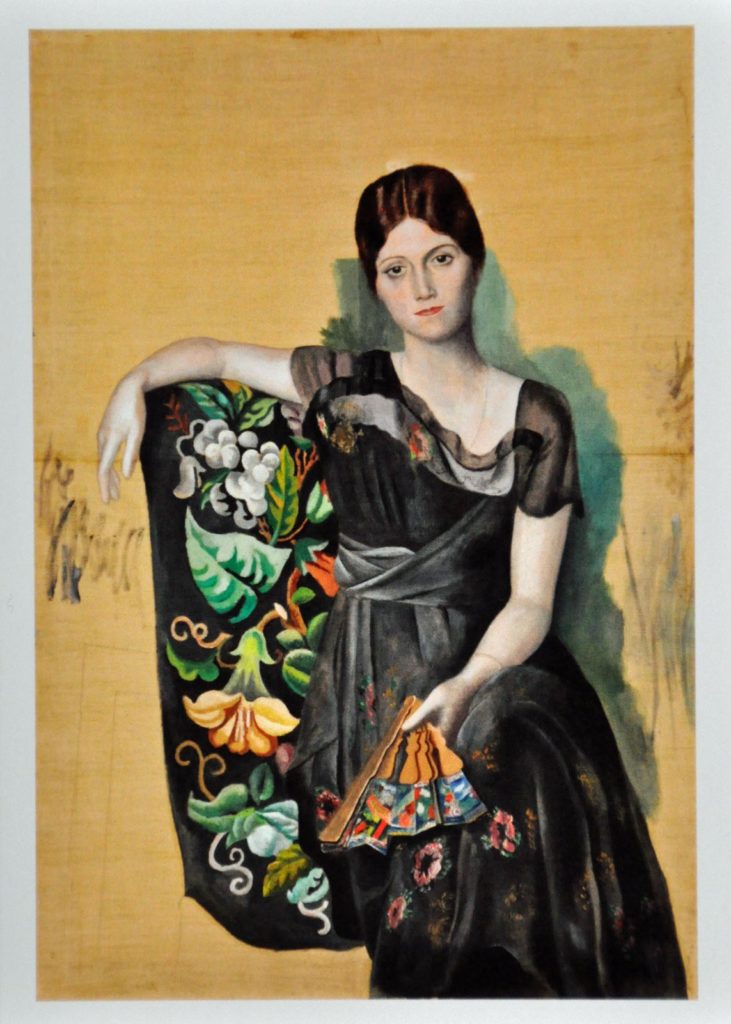
Mostly 10am on a Monday morning is a great time to see an exhibition, positively relaxed and often empty, but this Monday it was buzzing. There are two major exhibitions on and one of them, Picasso 1932, has just opened.
1932 was an intensely creative period in the life of the 20th century’s most influential artist. Always prolific, he was just 51 years old, established and seeing younger artists nipping at his heels whilst his contemporary Matisse seemed a creative powerhouse.
There are some pictures from outside of the year, mainly to put his work into context, but there really are an amazing number works for just one year.
This is the first ever solo Pablo Picasso exhibition at Tate Modern. It brings people face-to-face with more than 100 paintings, sculptures and drawings, mixed with family photographs and rare glimpses into his personal life. It is a huge exhibition, entirely unexpected in the context of just one year’s work.
By 1932 Picasso was married to the dancer Olga Khokhlova but had begun a relationship with the much younger Marie-Therese Walter.
His artwork Woman with dagger is a fairly straightforward reference to the rivalry and conflict in his love life
Thought the January of 1932 Picasso painted a series of pictures of a woman, almost certainly Marie-Therese Walter, sitting in an armchair, reading, sleeping or apparently listening to music. despite the common subject they all have a surprisingly different feel to them.
& in the middle of these seated figures are some still lives.
In early March 1932 Girl before a Mirror was completed, echoing a famous work by Manet.
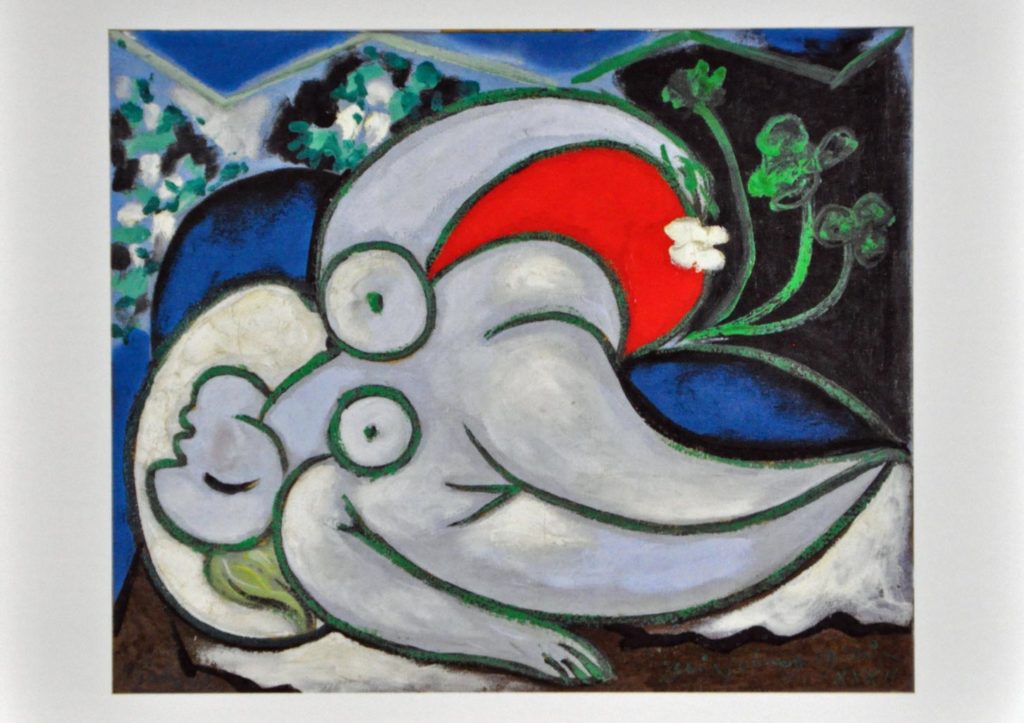
A series of large horizontal nudes was completed in April.
Possibly influenced by the appearance in Europe of Japanese erotica or “shunga” art.
Picasso painted a number of reclining nudes in June/July of 1932.
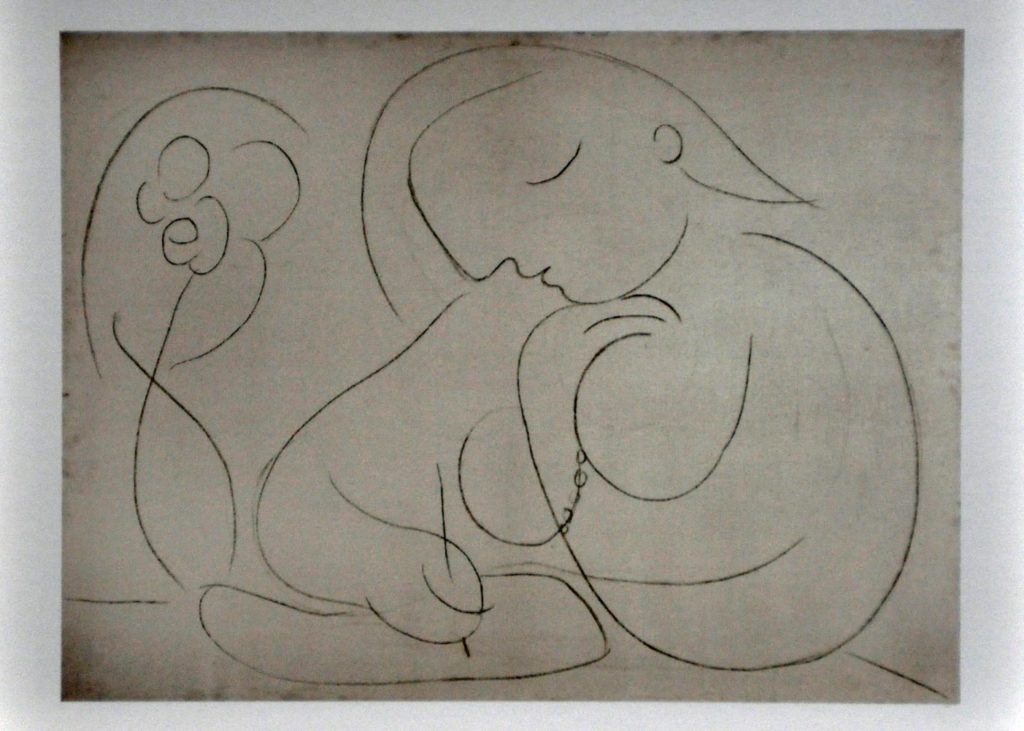
Within the show there are also a number of his charcoal drawings, not studies but completed works in their own right.
In September Picasso engaged with more classical themes including religious such as the crucifiction.
Towards the end of the year the theme of his painting turned darker, towards drowning and the possibility of rescue, maybe because of an incident involving his young lover (Picasso could not swim).
The Bathers
Ball Players on the Beach
Woman on the BeachThe Rescue
By the end of the year, his young lover was pregnant and his had wife left him with their son. The political and economic situation in Europe was deteriorating rapidly. Hitler had been appointed Chancellor in Germany and Mussolini had consolidated his hold on Italy. Spain became engulfed in a civil war in 1933 and within six months the world was once more at war
Asam Laksa is a flavorful, tangy, and spicy Malaysian fish based rice noodle soup, which is obviously not something a vegetarian can eat. This is therefore not a recipe for purists, but it works for my family.
Ingredients
1 pot of tamarind paste
8cupswater(2 liters)
A protein, which could be omelette strips, tofu, tempeh – whatever takes your fancy
12 to 15stalksdaun besom ie. polygonum/Vietnamese coriander or if you can’t find an asian store – mint/coriander half and half with a dash of lime
2tbspsugar
2tspsalt
2packetsfresh thick rice noodles(30 oz/950g) or 10 oz (283g) dried thick vermicelli***
Garnish
1small cucumber(julienned)
½pineapple(julienned) or half a fresh mango
1red onion(thinly sliced)
2red chilies(seeds removed and thinly sliced)
6stalksmint leaves(stem removed)
1lime(cut into wedges)
Spice Paste
3 tsp chilli
3red chilies(seeded and cut into pieces)
2 onions(peeled, chopped)
2stalks lemongrass(bottom third only, thinly sliced)
1inchfresh turmeric(peeled) (30g)
1 tbsp miso paste
Instructions:
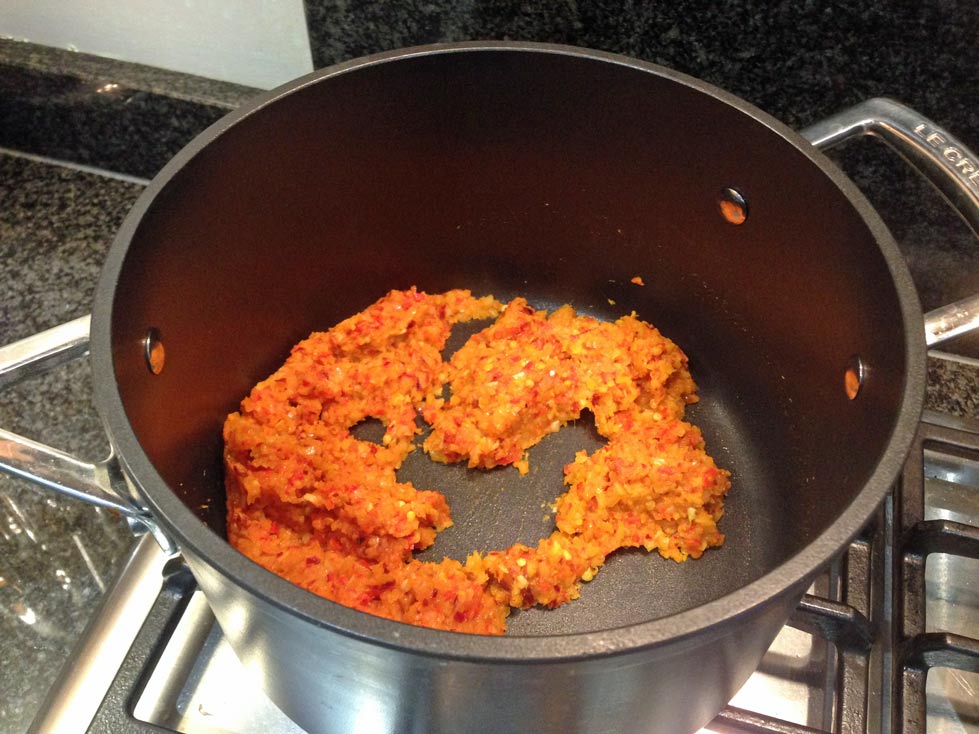
Blend spice paste ingredients with ¼ cup (60ml) water in a food processor
Place tamarind in a saucepan. Make upto 2litres with hot water.
Add blended spice paste, and other ingredients to . Bring to a boil, lower heat, and allow it to simmer for 20 minutes while you prepare the fish substitute such as an omelette or drained silken tofu. Add to pot.
Season the soup with sugar and salt.
Cook noodles in boiling water for 1 to 2 minutes. Remove and strain. Serve
Place some noodles in a bowl. Top with a little julienned cucumber, pineapple, onion, red chili, mint leaves etc. Pour gravy over the noodles.
Serve immediately with lime wedges.
Recipe Notes
**If tamarind paste is not available, 1 to 2 teaspoon (depending on taste) tamarind concentrate may be used instead.
***Dried thick vermicelli should be cooked in boiling water for a minute. Then turn off heat and let it soak for 6 to 8 minutes until soften. Remove and drain before serving.
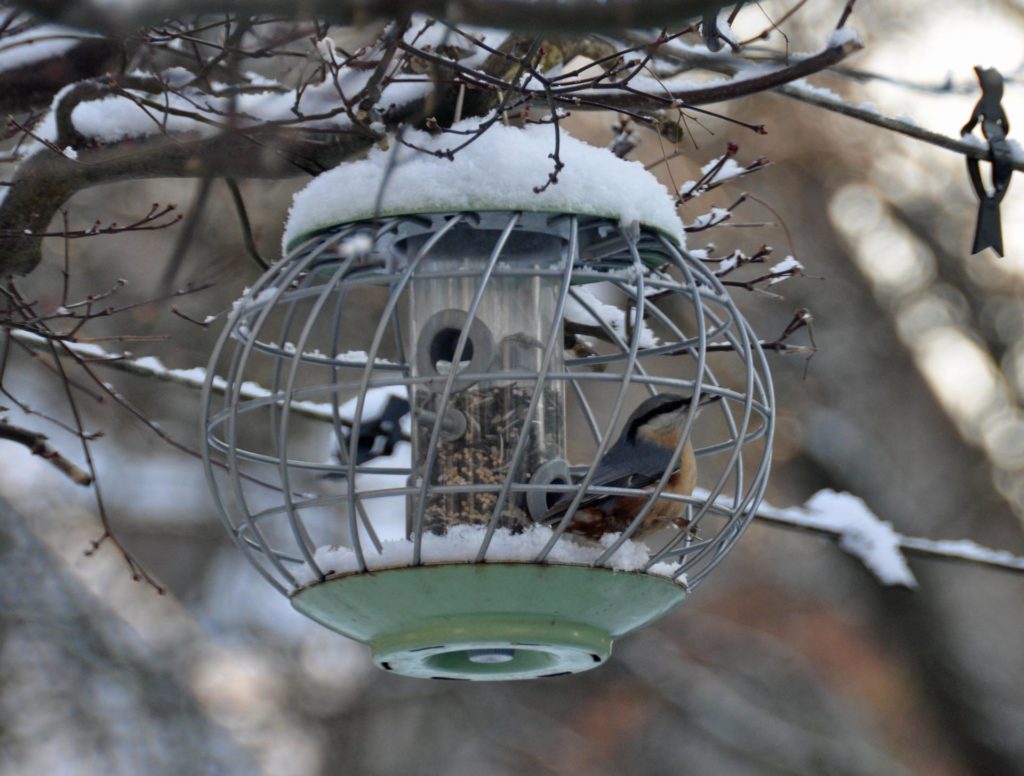
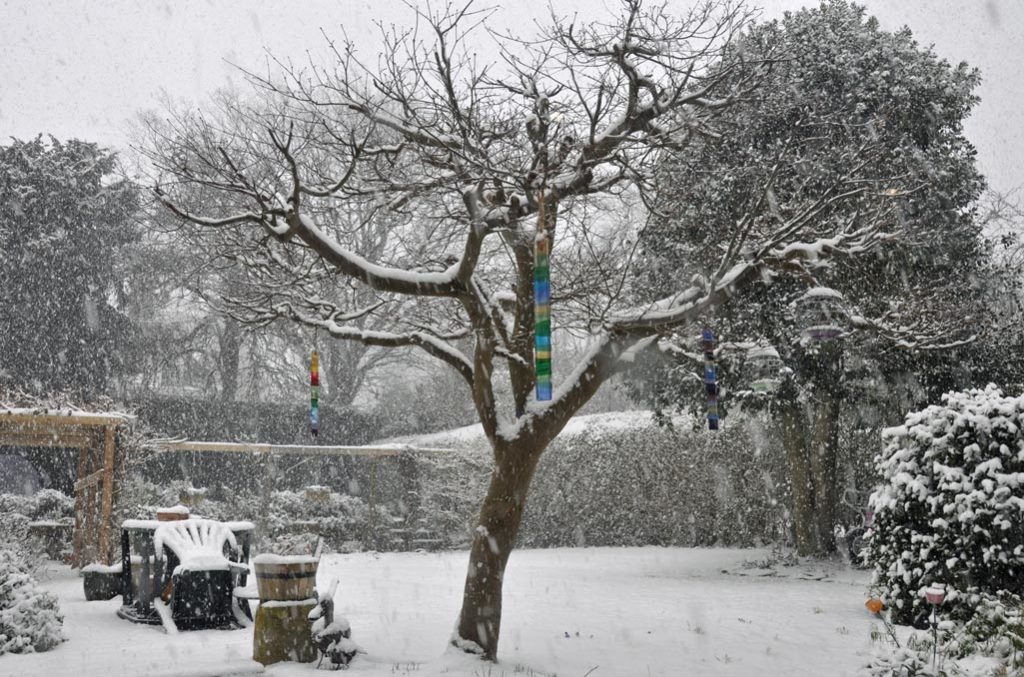
The snow has fallen and kept falling. The cats are going stir crazy, kept sane only by the many visitors to the bird feeder.
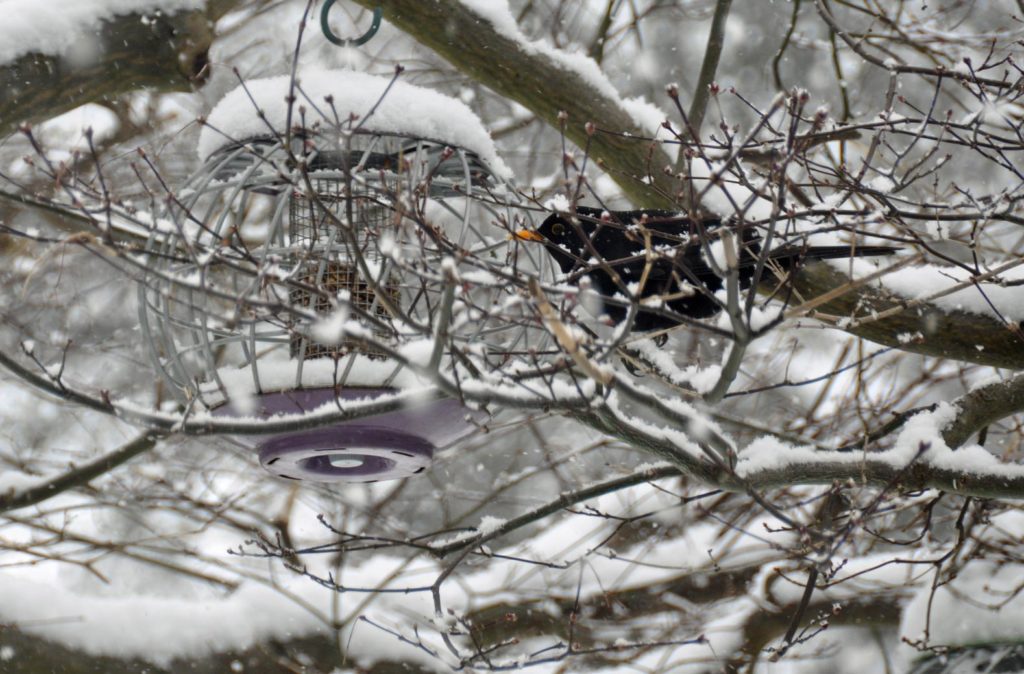
As well as the usual blue tits, we’re seeing a regular nuthatch pair, and perhaps saddest of all a blackbird that keeps trying and failing to hop across to the caged feeder.
Food so close, yet so far
He gets relegated, along with the London pigeons to the ground beneath the feeder but he’s not the only one lurking around.
Hunting for food under the bird feeder
Maybe a nocturnal hunt for scraps beneath the feeders explains away the success of the cats bringing home mice. It’s not as if these cats are particularly clever or even sneaky.
Spotted
And whilst the fox has nothing to fear from the cats, the blackbird is altogether more vulnerable, to both cats and fox.
Unimpressed by the snowNuthatch
Much safer up in the trees away from the predators.
We are told that the world of work is heading towards another revolution, where many jobs will be automated out of existence. It seems peculiar that one of the countries that is so very busy building the technology to bring about this end, is one that in some respects, resists automation so fiercely.
Japan is a unique culture. In a small Japanese tempura bar, you could easily see a lone chef, a man in late middle age, cooking behind a counter for no more than 11 customers. The set menu might have 15 items on it. That means that at any given moment, the chef will be keeping track of 165 pieces of food, each subject to slightly different timing and technique. You would not see him write anything down, expending no apparent effort. It is an everyday demonstration of total mastery. This doesn’t look so much like a job as a life.
In Japan, there is often a deep personal investment made by people in their work. The word shokunin, which has no direct translation, sums it up: It means something like “master or mastery of one’s profession,” and it captures the way Japanese workers spend every day trying to be better at what they do.
Shokunin culture can have a side that, to those of us raised on a more brutally capitalistic worldview, verges on the ridiculous. It is not unusual to see men standing with a yellow glow stick, pointing pedestrians toward the pavement instead of to the parking lot nearby. Presumably, if a vehicle comes, they point towards the car park. The man is basically acting as a sign, a job that has already been automated away in most other developed societies.
Occasionally one can find a group of men drilling a hole in the road. Or possibly, just one of them digging; with the others four watching him. For the whole 30 minutes, that’s all that happens but it isn’t done reluctantly, or while checking their smartphones, or gossiping, or anything. It was purposeful.
This can be dismissed simply as people whose jobs involve literally doing nothing except that for the people involved it certainly looks and feels as if their work is meaningful. For these workers, the value they attached to work doesn’t seem to be simply its economic value.
A Japanese train conductor bows on entering and exiting a train compartment; a department-store worker does the same thing coming or going from a shop floor, whether observed or not, whether the store is heavingly busy or almost deserted. It’s clear that there are deep cultural differences at work here, not all of them benign; the reason Japanese has a word for “death from overwork” is because it needs one. You could even argue that work has too much meaning, is too freighted with consequences for individual identity, in Japan.
Among economists, Japan is a byword, a punch line, a horror story. The boom of the late ’80s and early ’90s — during which it became popular to imagine a Japan-dominated economic future, the subject of Michael Crichton’s thriller “Rising Sun,” for instance — was followed by a spectacular stock-market crash. The Nikkei share index hit a high of 38,957 on Dec. 29, 1989. Over the next two decades, it fell 82%. Twenty-seven years later, it is still only at less than half that 1989 value. Property values crashed along with share prices, which turned large parts of the financial system into zombie banks — meaning banks that hold so many bad assets that they are essentially broke, which means they can’t lend money and therefore cease to fulfill one of a bank’s central roles in the modern economy, which is to help keep the flow of credit moving.
The Japanese economy ground to a halt. Inflation slowed, stalled and turned to outright deflation. Add Japan’s aging and shrinking population, contracting G.D.P. and apparently unreformable politics, and you have a picture of perfect economic gloom.
It doesn’t feel like that when you visit, though. The anger apparent in so much of the developed world simply isn’t visible in Japan.
A student of the culture would tell you that public displays of anger are frowned on in Japan; a demographer would point to the difficult prospects faced by young Japanese, paying for an older generation’s lavish health care and benefits that they are unlikely ever to enjoy themselves. The growth numbers would seem to imply a story about stagnation. But unemployment is almost nonexistent — at 3%, it’s among the lowest in the developed world. The aging of the society is visible, but so is the distinctive liveliness of the various youth cultures. I’ve been to plenty of stagnant places, and lived in one or two as well, and contemporary Japan isn’t one of them.
Why? A big part of the answer, I think, lies in the distinctive Japanese attitude toward work — or more specific, toward meaning in work.
Work is good, but meaningful work is better.
Does our shiny new Western world of work — post-manufacturing, un-unionized, gig-based, insecure — offer as much sense of meaning as work once did, or as it still seems to in Japan? In Derek Walcott’s epic poem “Omeros,” a wide-ranging reimagining and mash-up of Homer’s Aegean and the contemporary Caribbean, he writes admiringly and respectfully of his protagonist, Achille, a St. Lucian fisherman. Achille is a man “who never ascended in an elevator,/who had no passport, since the horizon needs none,/never begged nor borrowed, was nobody’s waiter.”
Near the end of Walcott’s long, meditative, elusive poem, that line gave me a jolt. What’s so bad about waiting tables? Is there really something so lessening, something analogous to begging or borrowing, about being a waiter?
The answer to that question for lots of people is “yes”. This isn’t a general human truth about workers at all times and in all cultures, because there are places where waiting and where service in general are deeply respected jobs. But it’s apparent that the new service work has many people doing things that aren’t congruent with their sense of their identity.
For many people, their personal story or narrative has become one of decline and loss, of reduction in self-esteem. The tension in status between different types of work is one theme of Karl Ove Knausgaard’s “My Struggle” — indeed, that is essentially what his struggle is, the gap between the narrator’s sense of what he should be doing, as a writer, and what he actually does all day, as a homemaker: “Clean floors, wash clothes, make dinner, wash up, go shopping, play with the children in the play areas, bring them home, undress them, bathe them, look after them until it is bedtime, tuck them in, hang some clothes to dry, fold others, and put them away, tidy up, wipe tables, chairs and cupboards.”
It’s sometimes said that the value of manufacturing work is exaggerated, and that we should just get used to the idea that most jobs are now in service industries — which is probably true. But unionized manufacturing work gave a sense of community and meaning that more atomized, more modern, more service-based work struggles to do. It doesn’t matter that many of those old jobs were boring, or brutally repetitive, or dangerous, or made workers sick — or, like coal mining, all of those things simultaneously.
In the 1937 speech where Franklin D. Roosevelt called for “a fair day’s pay for a fair day’s work,” he stressed that “the overwhelming majority of our population earns its daily bread either in agriculture or in industry.” Hard manual work created tangible products, and that tangibility was part of what made the work seem meaningful. Miners and autoworkers, laborers in the clothing and electrical and transportation industries, had a social cohesion based on the fact that they worked and sweated and lived and suffered together, creating a tangible product that seemed to them imbued with national, even world-historical, significance.
The danger is that a class identity founded on collective labour is replaced by an identity founded on resentment, further destabilizing our politics. As Japan shows us, there are worse things for a society than calmly growing old together.
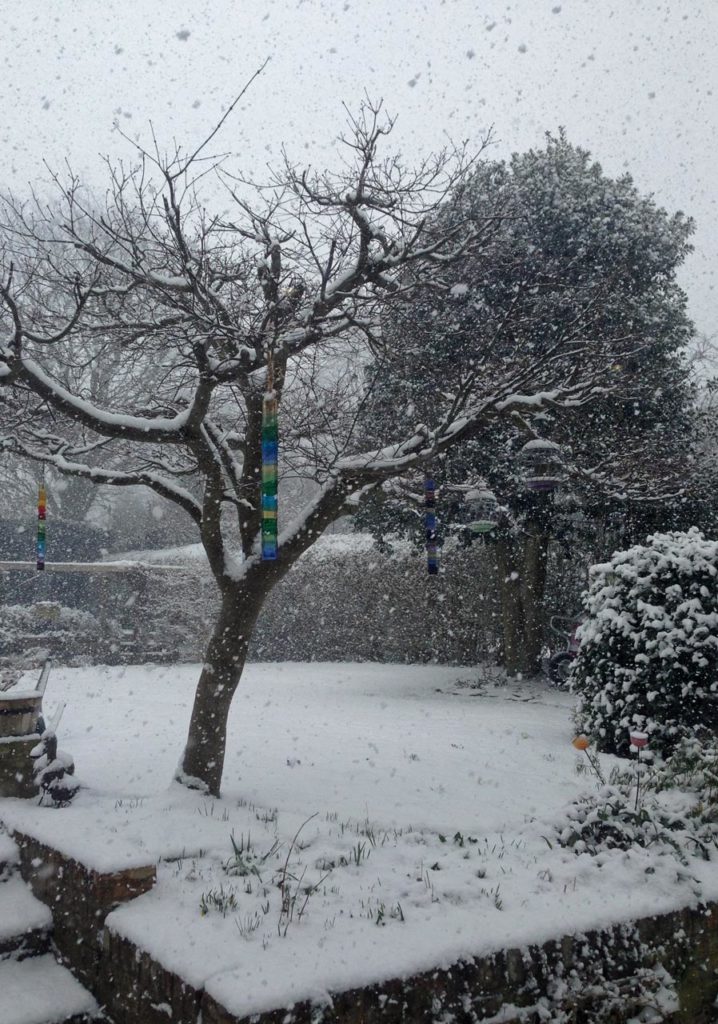
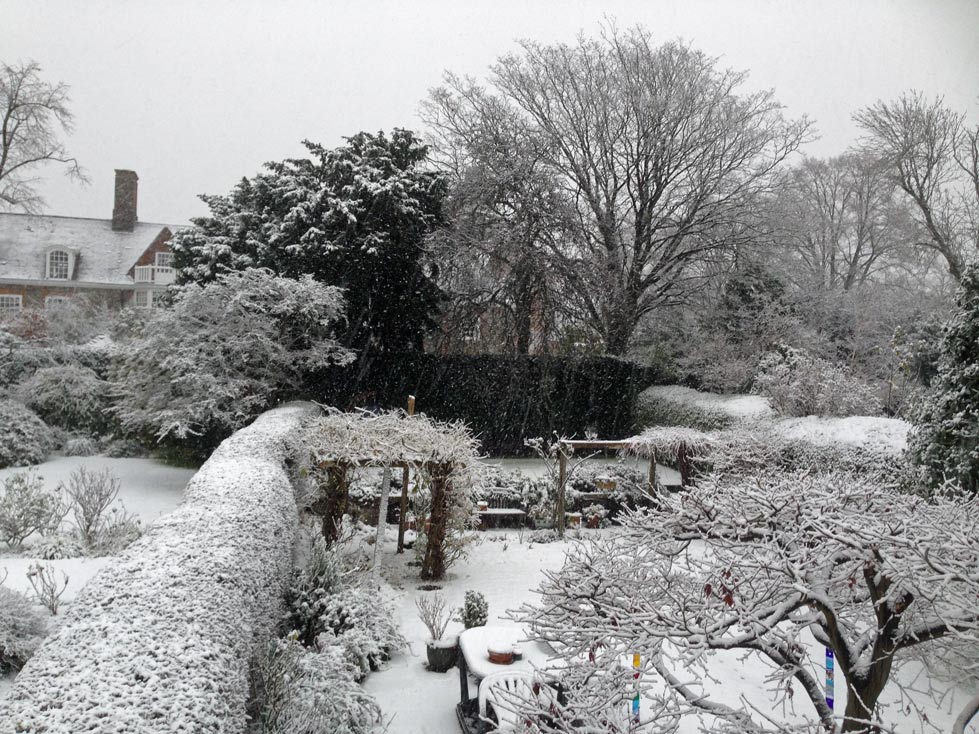
Today is a day for staying home, lighting the fire and bumbling about.
Unusually, the snow has arrived in London, and is now spread across the entire country. In many places we are seeing red weather warnings ie. threat of life, across the south east and Scotland.
Schools are closed and the roads are snowed up. Even after salting, the snow is coming down so quickly that it’s becoming more and more difficult to get out and about so staying home seems the only sensible option.
I’ve ordered an electric blanket for the eldest away in a cold rental home at university and had it delivered this morning. It might be silly but I really hate the idea of her being cold in the night. Her plans are to visit a neighbour who had a stroke a year back and whose dog she has been walking weekly. She’s worried that he doesn’t have the heating on much and maybe could use some help getting some basic groceries to stock up. Without pausing for breath she noted the chance that she might find him dead or struggling – it’s time to be a good neighbour.
The snow is predicted to continue right through to the weekend so I’ve warned her to stock up for the long term – the snow is only going to get deeper and colder.
An Elizabeth David version of everlasting syllabub
One small glass or 4oz, of white wine or sherry;
2 tablespoons of brandy;
one lemon;
2oz of sugar;
½ pint of double cream; and,
nutmeg.
The day before the syllabub is to be made, put the thinly pared rind of the lemon and the juice in a bowl with the wine and brandy and leave overnight. Next day, strain the wine and lemon mixture into a large and deep bowl.
Add the sugar and stir until it has dissolved. Pour in the cream slowly, stirring all the time. Grate in a little nutmeg.
Now whisk the mixture until it thickens and will hold a soft peak on the whisk. The process may take 5 minutes, it may take as long as 15. It depends on the cream, the temperature and the method of whisking.
When the cream is ready, spoon it into glasses, which should be of very small capacity (2 to 2½ oz) but filled to overflowing. Once in the glasses the cream will not spoil nor sink nor separate. A tiny sprig of rosemary or a little twist of lemon peel can be stuck into each little filled glass. Keep the syllabubs in a cool place – not in the refrigerator – until you are ready to serve them.
They can be made at least two days before they are needed. The quantities given will fill 10 small syllabub or custard cups or sherry glasses and will be enough for four to six people.
All about me!
This website uses cookies to improve your experience. We'll assume you're ok with this, but you can opt-out if you wish.AcceptRejectRead More
Privacy & Cookies Policy
Privacy Overview
This website uses cookies to improve your experience while you navigate through the website. Out of these, the cookies that are categorized as necessary are stored on your browser as they are essential for the working of basic functionalities of the website. We also use third-party cookies that help us analyze and understand how you use this website. These cookies will be stored in your browser only with your consent. You also have the option to opt-out of these cookies. But opting out of some of these cookies may affect your browsing experience.
Necessary cookies are absolutely essential for the website to function properly. This category only includes cookies that ensures basic functionalities and security features of the website. These cookies do not store any personal information.
Any cookies that may not be particularly necessary for the website to function and is used specifically to collect user personal data via analytics, ads, other embedded contents are termed as non-necessary cookies. It is mandatory to procure user consent prior to running these cookies on your website.
Manage Cookie Consent
To provide the best experiences, we use technologies like cookies to store and/or access device information. Consenting to these technologies will allow us to process data such as browsing behavior or unique IDs on this site. Not consenting or withdrawing consent, may adversely affect certain features and functions.
Functional
Always active
The technical storage or access is strictly necessary for the legitimate purpose of enabling the use of a specific service explicitly requested by the subscriber or user, or for the sole purpose of carrying out the transmission of a communication over an electronic communications network.
Preferences
The technical storage or access is necessary for the legitimate purpose of storing preferences that are not requested by the subscriber or user.
Statistics
The technical storage or access that is used exclusively for statistical purposes.The technical storage or access that is used exclusively for anonymous statistical purposes. Without a subpoena, voluntary compliance on the part of your Internet Service Provider, or additional records from a third party, information stored or retrieved for this purpose alone cannot usually be used to identify you.
Marketing
The technical storage or access is required to create user profiles to send advertising, or to track the user on a website or across several websites for similar marketing purposes.